
US-Iran tensions ease and US consumer confidence plunges, weak dollar narrative reignites

Wallstreet.cn April 14 Report—— The US dollar index continues its decline as US-Iran tensions ease and consumer confidence drops, reigniting the weak dollar narrative across the board.
On Tuesday (April 14), during the Asian and European sessions, the US dollar index continued its sharp fall after Monday’s spike and retracement, currently trading at 98.21, down 0.2%. The stage-wise weakness of the dollar index has become even more apparent.
Although Iran continues to send tough signals—its Defense Ministry spokesperson rejected the US’s attempts to intervene militarily in the Strait of Hormuz and the Gulf of Oman, and warned that attacks on Iranian ports would cripple navigation across the Persian Gulf—expectations of resumed negotiations have already eased extreme risk aversion in the market, and the dollar's previous safe-haven surge driven by geopolitical conflicts has officially collapsed.
The Dollar’s Safe-Haven Attribute Is Conditional; Geopolitical Easing Triggers Correction and Validates Logic
The dollar’s sharp appreciation during the crisis peak aligns with the logic of safe-haven currencies, but its post-crisis pullback does not overturn this role—instead, it confirms a core principle: the dollar’s safe-haven effect only peaks at moments of market risk; as immediate liquidity demand drops, support for risk aversion weakens quickly.
However, when the risk source is not a global liquidity crisis and as geopolitical tensions ease, safe-haven demand for the dollar quickly fades, naturally putting downward pressure on the exchange rate;
At the same time, US domestic policy risks actually weigh on the dollar, and geopolitical risk alone does not serve as an independent driver for the dollar—its safe-haven mechanism only functions during crises, and does not possess permanence.
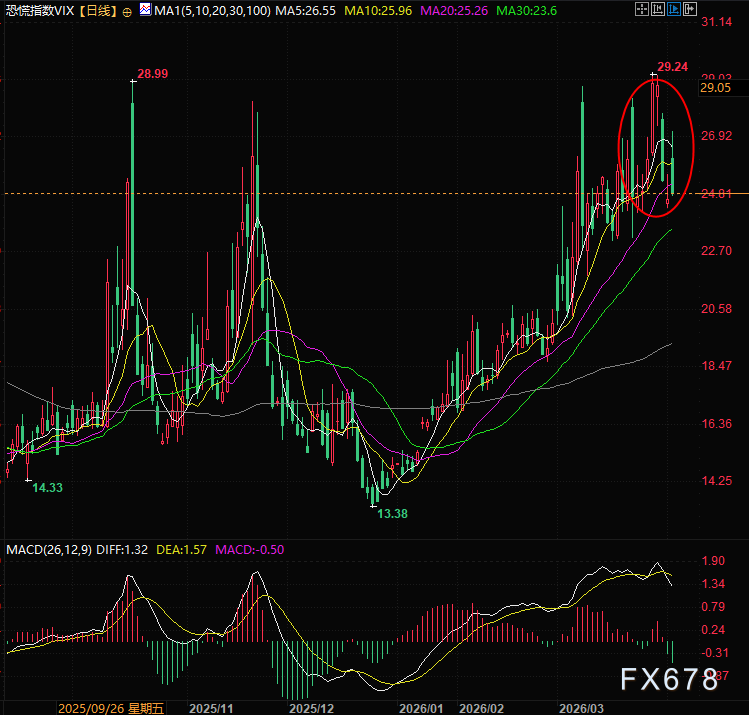
(Daily VIX chart, Source: Wallstreetcn’s EasyForex platform)
The Iran War Severely Damages Economy, US Consumer Confidence Plunges, Weighing on the Dollar
University of Michigan polls show consumer confidence continues its downward trend since the outbreak of war, with confidence dropping across all groups, down 9% year-on-year; business environment expectations fell 20%, personal finance evaluations dropped 11%, with high prices and asset declines as major pressures.
The overlap of geopolitical conflict and weakening confidence has severely hurt the US auto industry, with high prices suppressing durable goods consumption. The market is attributing economic underperformance to the Iran conflict;
The instability in the Middle East has also exacerbated risks in the global auto supply chain, pushing up volatility in energy and raw material prices.
Bank of America data shows that after the outbreak of the Iran conflict, reliance on card payments among Americans surged; as of the week ending March 28, total spending rose 4.7% year-on-year, with gasoline and online spending spiking, but department store, furniture, and home improvement consumption continued to shrink. Faced with economic uncertainty, people began to cut back on expenditures, and the increased reliance on card payments among high-income households further highlights financial pressure.
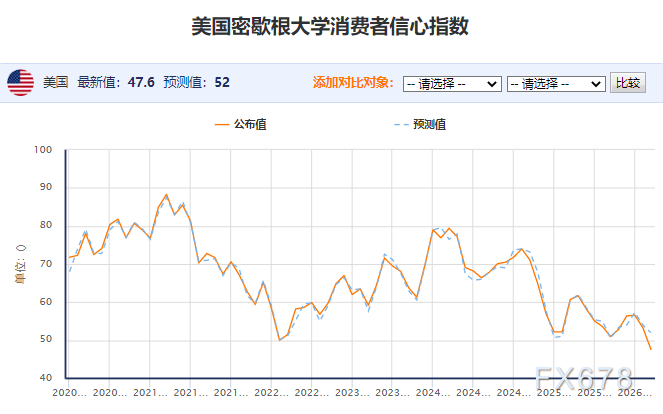
(University of Michigan Consumer Confidence Index trend, Source: Wallstreetcn’s EasyForex platform)
Deteriorating Consumption Structure and Weak Economy Reinforce Weak Dollar Expectations
At the same time, US inflation expectations have surged sharply. In April, one-year inflation expectations jumped from 3.8% to 4.8%; long-term inflation expectations hit their highest since November 2025. Consumer confidence had already sunk to a stage low in March, and mid-to-high-income groups are especially affected by fluctuations in oil prices and markets.
With both a retreat in risk-aversion and weakening domestic economic fundamentals, the weak dollar narrative has heated up fully, and the short-term weak trend in the dollar index has become further established.
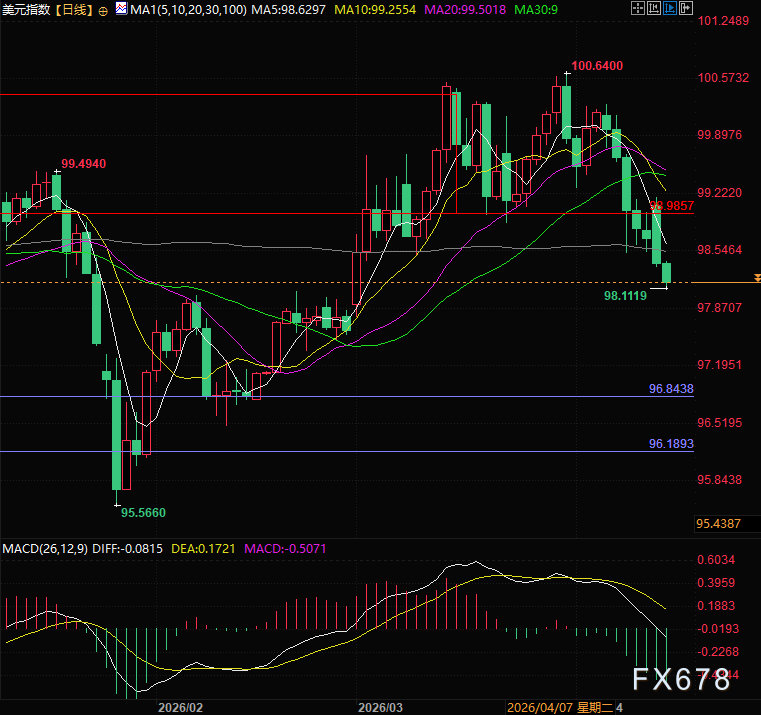
(Daily US dollar index chart, Source: Wallstreetcn’s EasyForex platform)
Gold Falls Short in the Short Term, But the Dollar Remains the Core Liquidity Carrier in Crisis
During this Iran conflict, gold underperformed expectations, falling over 25% from its historical high. The core reason is that, in times of crisis, investors prioritize closing positions and liquidating holdings for dollar liquidity; combined with inflation pushing up bond yields, the opportunity cost of holding non-interest-bearing gold has increased.
In the long run, gold will still appreciate after extreme risks, but during the crisis window, the dollar’s core status as the primary liquidity vehicle is irreplaceable.
It is worth being alert to the fact that the dollar’s stage-by-stage appreciation tightens global financial conditions, accelerating the process of global de-dollarization. The dollar’s risk-aversion mechanism itself contains the hidden risk of self-weakening, and its long-term status depends on the evolution of the global financial system.
Disclaimer: The content of this article solely reflects the author's opinion and does not represent the platform in any capacity. This article is not intended to serve as a reference for making investment decisions.
You may also like
Citadel Just Filed a 13F on Canary XRP ETF. Here’s the Significance
XCX fluctuated 41.7% in 24 hours: rebounded from a low of $0.003255 to $0.004553, with no major news catalyst
BDXN fluctuated 95.9% in 24 hours: price surged from a low of $0.00195 to a high of $0.00382
Trending news
MoreCrypto prices
More





