
Wall Street Analysts Think Sonos (SONO) Could Surge 28.21%: Read This Before Placing a Bet

The average comprises three short-term price targets ranging from a low of $18.00 to a high of $21.00, with a standard deviation of $1.73. While the lowest estimate indicates an increase of 15.4% from the current price level, the most optimistic estimate points to a 34.6% upside. More than the range, one should note the standard deviation here, as it helps understand the variability of the estimates. The smaller the standard deviation, the greater the agreement among analysts.
While the consensus price target is highly sought after by investors, the ability and unbiasedness of analysts in setting price targets have long been questionable. And investors making investment decisions solely based on this tool would arguably do themselves a disservice.
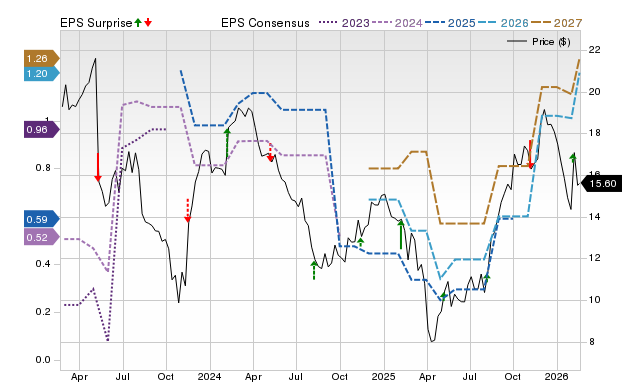
But, for SONO, an impressive average price target is not the only indicator of a potential upside. Strong agreement among analysts about the company's ability to report better earnings than they predicted earlier strengthens this view. While a positive trend in earnings estimate revisions doesn't gauge how much a stock could gain, it has proven to be powerful in predicting an upside.
Price, Consensus and EPS Surprise
Here's What You May Not Know About Analysts' Price Targets
According to researchers at several universities across the globe, a price target is one of many pieces of information about a stock that misleads investors far more often than it guides. In fact, empirical research shows that price targets set by several analysts, irrespective of the extent of agreement, rarely indicate where the price of a stock could actually be heading.
While Wall Street analysts have deep knowledge of a company's fundamentals and the sensitivity of its business to economic and industry issues, many of them tend to set overly optimistic price targets. Are you wondering why?
They usually do that to drum up interest in shares of companies that their firms either have existing business relationships with or are looking to be associated with. In other words, business incentives of firms covering a stock often result in inflated price targets set by analysts.
However, a tight clustering of price targets, which is represented by a low standard deviation, indicates that analysts have a high degree of agreement about the direction and magnitude of a stock's price movement. While that doesn't necessarily mean the stock will hit the average price target, it could be a good starting point for further research aimed at identifying the potential fundamental driving forces.
That said, while investors should not entirely ignore price targets, making an investment decision solely based on them could lead to disappointing ROI. So, price targets should always be treated with a high degree of skepticism.
Why SONO Could Witness a Solid Upside
Analysts' growing optimism over the company's earnings prospects, as indicated by strong agreement among them in revising EPS estimates higher, could be a legitimate reason to expect an upside in the stock. That's because empirical research shows a strong correlation between trends in earnings estimate revisions and near-term stock price movements.
For the current year, one estimate has moved higher over the last 30 days compared to no negative revision. As a result, the Zacks Consensus Estimate has increased 56.8%.
Moreover, SONO currently has a Zacks Rank #1 (Strong Buy), which means it is in the top 5% of more than 4,000 stocks that we rank based on four factors related to earnings estimates. Given an impressive externally-audited track record, this is a more conclusive indication of the stock's potential upside in the near term. You can see the complete list of today's Zacks Rank #1 (Strong Buy) stocks here >>>> .
Therefore, while the consensus price target may not be a reliable indicator of how much SONO could gain, the direction of price movement it implies does appear to be a good guide.
Disclaimer: The content of this article solely reflects the author's opinion and does not represent the platform in any capacity. This article is not intended to serve as a reference for making investment decisions.
You may also like
Korean Analyst Expects XRP Channel to Push Prices to $5

 VIPKevin Warsh Sworn in as Fed Chair, Putting Broad Pressure on Crypto Assets
1. Following Kevin Warsh's appointment as Fed chair, the Fed has shifted back toward a more conservative policy stance. His hawkish position — that rates should not be cut before inflation returns to target — has significantly pushed back market expectations for easing. Holding rates steady throughout the year has now become the market's base-case scenario, while tail risks of further hikes are also beginning to be priced in. Expectations for global liquidity are tightening, although total stablecoin market capitalization in crypto continues to reach new all-time highs, with USDGO emerging as one of the fastest-growing stablecoins. 2. 10-year sovereign bond yields across major developed economies surged sharply this week: Japan climbed above 2.75% to multi-decade highs, the U.S. reached 4.57%, the UK touched 4.92%, and Germany rose to 3.14%. Yield volatility reached 3–4 sigma levels during the week, marking one of the most extreme moves since the 2022 UK pension crisis. Risk-off sentiment strengthened significantly, with capital rotating away from risk assets and into defensive assets. 3. BTC declined 1.96% this week, but the OBV volume-price divergence strategy delivered the strongest performance with +4.46% alpha. The strategy focuses on price-volume divergence signals: when price makes a new range low but OBV does not confirm with a new low, it treats this as a sign that selling momentum is fading and executes a contrarian buy on the 5-minute timeframe. Assets to watch: BTC, ONDO, HYPE, NEAR, PDD (earnings on May 27), MRVL, CRM, DELL.

StablR loses parity after attack generates $13,5 million in fake news.
Nikkei 225 surpasses 65 points amid easing oil prices.
Trending news
MoreCrypto prices
More





