
The Growing Popularity of Momentum ETFs Amid Market Volatility: Tactical Portfolio Allocation and Optimizing Risk-Adjusted Performance in 2025
- Momentum ETFs surged 74.8% in 2023 and 72.7% in 2024 but faced a 4.3% average loss in 2025 amid volatility and macroeconomic uncertainty. - Quality/value ETFs like QUAL and AVUV showed greater resilience during downturns, contrasting momentum strategies' lack of defensive characteristics. - 2025 market shifts highlighted risks of overvaluation in momentum sectors, with tech indices diverging from economic fundamentals. - Strategic diversification through hedging (VIXY/UVXY), alternative assets (VTIP), an
Momentum ETFs: Navigating Volatility and Opportunity from 2023 to 2025
Over the last three years, investors have experienced dramatic market swings, moving rapidly between optimism and anxiety. Momentum ETFs, which were standout performers in 2023 and 2024, encountered significant headwinds in 2025 as heightened volatility and shifting economic conditions challenged their stability. Despite these challenges, momentum strategies can still play a vital role in tactical portfolios—if investors approach them with careful risk management, diversification, and a solid grasp of their inherent risks.
The Momentum Journey: 2023–2025 in Review
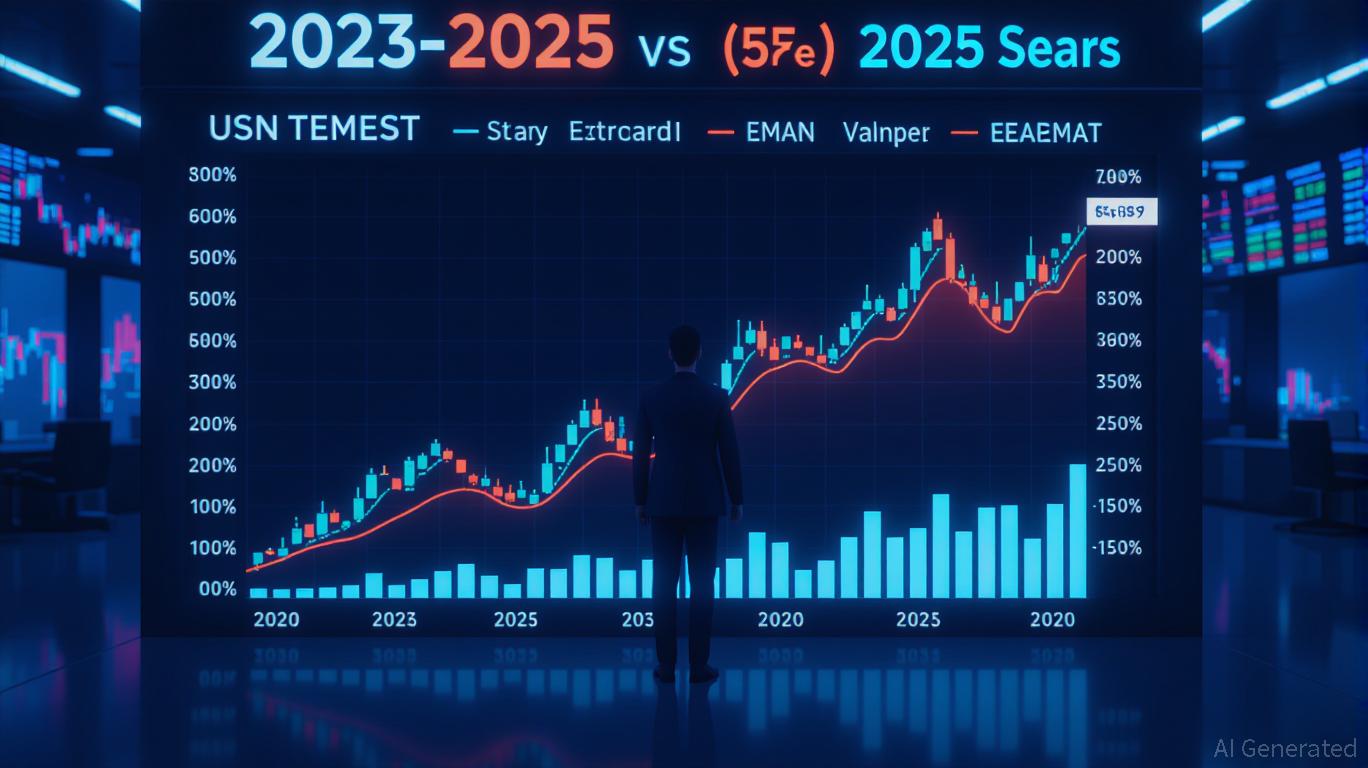
Momentum ETFs delivered impressive gains in the early part of this cycle, soaring by 74.8% in 2023 and climbing another 72.7% in 2024. However, 2025 brought a sharp reversal, with the sector experiencing an average decline of 4.3%, as reported by Morningstar. This pattern highlights a crucial reality: momentum strategies excel during strong market trends but can struggle when those trends shift. In contrast, ETFs focused on quality and value—such as the iShares MSCI USA Quality Factor ETF (QUAL) and the Avantis US Small Cap Value ETF (AVUV)—have demonstrated greater resilience during downturns, even if their returns lagged in 2025.
The main distinction lies in risk-adjusted performance. Momentum ETFs often pursue high-growth stocks but may lack the defensive features found in quality or value strategies. For instance, QUAL’s lower volatility and its ability to weather past crises, such as those in 2020 and 2022, underscore its stabilizing effect during turbulent times. Investors must balance the allure of rapid gains with the need for long-term portfolio strength.
2025 Market Dynamics: Sentiment and Macro Forces
Investor appetite for momentum ETFs in 2025 has been shaped by a blend of optimism and caution. The S&P Global Investment Manager Index (IMI) reflected improved risk appetite in November 2025, yet concerns about high valuations and ongoing economic uncertainty have kept enthusiasm in check. Geopolitical developments, including a 77% jump in the Bloomberg Europe Defense Select Index during the first half of 2025, have also steered investment toward sectors benefiting from clear macro trends.
At the same time, monetary easing by the U.S. Federal Reserve and supportive policies from the European Central Bank have fueled momentum in growth-oriented sectors like technology and artificial intelligence. In September 2025, momentum stocks outpaced the broader market by 113 basis points, buoyed by strong earnings and hopes for a soft economic landing. However, a widening gap between the S&P 500 technology sector index and the U.S. Technology sector PMI points to a disconnect between stock prices and underlying economic fundamentals—raising concerns about potential overvaluation.
Building a Resilient Portfolio: Integrating Momentum with Diversification
Effectively incorporating momentum ETFs into a diversified investment strategy requires careful attention to risk. Consider these approaches:
-
Tactical Risk Management
The DF Risk-Managed Momentum Index provides a model by alternating between momentum assets and treasuries based on market signals. Using exponential moving averages (EMAs) to identify shifts, this method can reduce losses during downturns by reallocating to safer assets, as seen during the 2025 correction. -
Volatility Hedging
Products like VIXY and UVXY offer short-term protection against sudden market shocks. Although these ETFs can lose value in certain market conditions, they are valuable during periods of heightened uncertainty, such as the policy changes and geopolitical events of 2025. Pairing momentum ETFs with volatility hedges can improve risk-adjusted returns while maintaining growth exposure. -
Diversifying with Alternative Assets
Insights from iShares and BlackRock in their 2025 outlooks highlight the importance of moving beyond traditional 60/40 portfolios. Adding digital assets, inflation-protected bonds, and global equities can provide returns that do not move in lockstep with momentum strategies. For example, the Vanguard Short-Term Inflation-Protected Securities ETF (VTIP) has historically performed well during market stress, making it a strong complement to momentum holdings. -
Active Management in Less Efficient Markets
In areas like small-cap and emerging markets, active ETFs such as the Overlay Shares Hedged Large Cap Equity ETF (OVLH) combine in-depth stock selection with options-based risk controls. These strategies can generate outperformance while managing downside risk, a key advantage in the fragmented environment of 2025.
Momentum Strategies for the Long Term
Although 2025 has posed challenges for momentum ETFs, their long-term prospects remain promising. The Avantis US Small Cap Value ETF (AVUV), for instance, has delivered annualized outperformance of 4.5% over its benchmark since launch, illustrating the potential for momentum approaches to succeed across full market cycles. The essential ingredients are patience and disciplined rebalancing, rather than chasing short-term trends.
Final Thoughts: Mastering Volatility in 2025 and Beyond
Momentum ETFs are not a universal solution, but they offer significant opportunities for investors who understand and manage their risks. By blending momentum exposure with hedging strategies, alternative investments, and active management, investors can benefit from market trends while safeguarding against inevitable corrections. As central bank policies and fiscal measures continue to influence the investment landscape, adaptability—in both strategy and mindset—will be the key to success in 2025 and the years ahead.
Disclaimer: The content of this article solely reflects the author's opinion and does not represent the platform in any capacity. This article is not intended to serve as a reference for making investment decisions.
You may also like
Aster DEX and the Next Phase of Decentralized Finance (DeFi): Assessing Entry Points for Individual Investors in the Changing DeFi Environment
- Aster DEX bridges retail-institutional DeFi gaps via zero-knowledge proofs and MiCA-compliant custody solutions, enhancing privacy and regulatory alignment. - Its Aster Chain Layer 1 blockchain enables fast, scalable trading while reducing reliance on external chains, addressing retail onboarding barriers through integrated fiat gateways. - Despite advancements, DeFi on-ramps remain fragmented, with institutional liquidity pools controlling 85% of assets, limiting retail influence and exposing compliance

Investor Interest Grows as GeekStake Highlights Its 2025 Staking Features
Vitalik Buterin Backs ZKsync: Accelerating the Evolution of Ethereum’s Layer 2 Solutions
- Vitalik Buterin endorsed ZKsync, highlighting its ZK rollup role in Ethereum's scalability and security. - ZKsync's Atlas upgrade achieved 30,000 TPS with Ethereum compatibility, driving ZK token's 120% surge to $0.74. - Institutional adoption grew with $3.3B TVL, 27M monthly transactions, and partnerships with Deutsche Bank/Sony. - ZKsync leads ZK rollups with $3.3B TVL vs. $1.2B (StarkNet), leveraging EVM compatibility and low fees. - Investors face opportunities in ZKsync's network effects and deflati
ZK Atlas Enhancement and Its Impact on Blockchain Scalability
- ZKsync's October 6, 2025 Atlas Upgrade introduces modular architecture with 15,000–43,000 TPS and $0.0001 ZK proof costs, enhancing blockchain scalability and EVM compatibility. - Deutsche Bank and UBS adopt the upgrade for cross-chain settlements, leveraging its cryptographic finality and real-time RWA tokenization capabilities. - Bitget projects 60.7% CAGR for ZK-based Layer-2 solutions, reaching $90B by 2031, driven by institutional demand for interoperable, compliant blockchain infrastructure. - Modu

Trending news
MoreCrypto prices
More





