
Arcade tokens are a ‘critical building block’ in crypto’s evolution: a16z

More crypto projects should consider using a blockchain-based equivalent to airline miles to grow their user base and power their economies, according to executives from venture capital firm a16z.
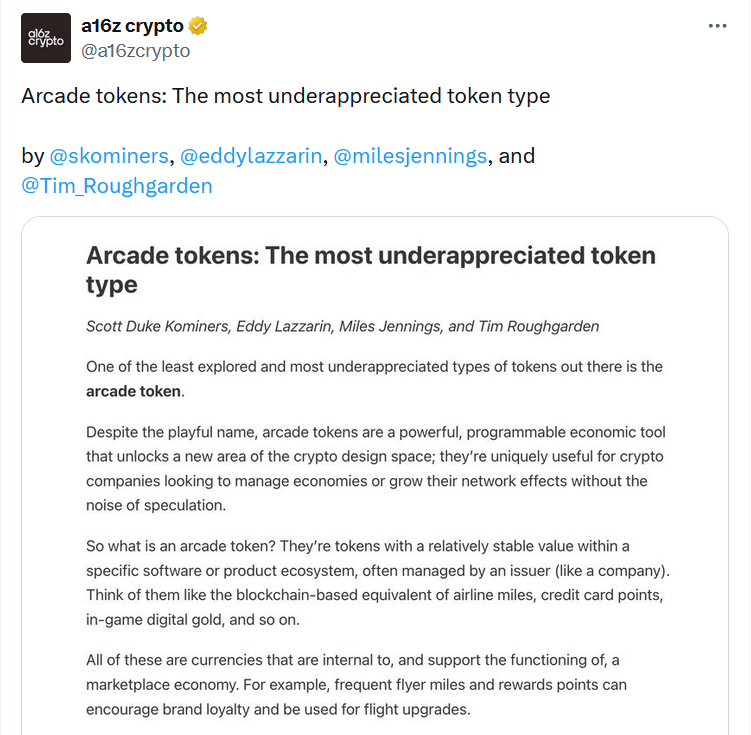
In a report published on Thursday, a16z stated that one of crypto’s most underappreciated token types is called “arcade tokens.”
These tokens maintain a relatively stable value within a specific software or product ecosystem, similar to airline miles rewards, credit card points or in-game currencies. They enable users to perform specific functions within that ecosystem, rather than being held for speculation.
“Though arcade tokens aren’t for every use case, they represent a critical building block in the evolution of crypto networks.”
“Just as stablecoins unlock new forms of commerce, and network tokens enable decentralized value-sharing and governance, arcade tokens can power digital economies at scale,” said a16z researcher Scott Duke Komimers, chief technology officer Eddy Lazzarin and others.
Arcade token usage
One such project, according to a16z, is the hospitality-tech startup Blackbird and its native $FLY token. The project launched a Web3 payments platform for restaurants in mid-2024, with $FLY designed to reward users and spur adoption of the service.
“Blackbird’s $FLY token allows users to redeem it in any participating restaurant, and that redemption behavior is managed on a purpose-built blockchain layer powered by a network token,” the report reads, as it pointed to other use cases:
“A decentralized computing network might, for example, use a network token for security and incentives among compute providers, while using an arcade token to establish network effects among the customer base.”
“Frequent flyer miles and rewards points, for example, can encourage brand loyalty and be used to make flight and upgrade purchases; digital gold can let you buy or sell items in a video game,” they explained, adding:
“Instead of granting holders ownership rights in the underlying ecosystem, arcade tokens grant holders the ability to access or use certain applications or services; crucially, their market value is designed to be programmatically bounded.”
The report also argued that arcade tokens can provide important utilities for “spend-centric economies or physical-world integrations.”
Some of the benefits of using arcade tokens include price stability and usability, which make it easy for users to understand what they’re spending, simply accounting, and simplify tokenomics for issuers.
Stablecoins and other assets vs arcade tokens
The report also highlights that while stablecoins can be used for similar purposes, the flexible dynamics of arcade tokens present other opportunities.
For example, issuers can essentially “print arcade tokens on demand” to support ecosystem growth, such as grants, user and developer subsidies, while also encouraging users to stay within the economy, instead of spending the funds elsewhere.
However, the report outlines that not every project needs to use them, as they lack utility in speculative environments or when a network or platform already has a well-established token and ecosystem.
“For example, layer one blockchain networks that have their own network tokens generally do not need arcade tokens to function,” they argued.
Disclaimer: The content of this article solely reflects the author's opinion and does not represent the platform in any capacity. This article is not intended to serve as a reference for making investment decisions.
You may also like
Zcash Halving: What It Means for Cryptocurrency Investors in 2025
- Zcash's 2028 halving will reduce annual inflation to 1%, reinforcing its deflationary model after prior 50% block reward cuts in 2020 and 2024. - The 2024 halving triggered 1,172% price surge followed by 96% drop, highlighting volatility risks despite growing institutional investments like Grayscale's $137M Zcash Trust. - Privacy-focused hybrid model (shielded/transparent transactions) attracts institutional interest but faces EU MiCA regulatory scrutiny, requiring selective compliance strategies. - Inve
CleanTrade and the Evolution of Clean Energy Markets: Market Fluidity, Openness, and the Role of the CFTC
- CleanTrade, a CFTC-approved SEF, transforms clean energy markets by integrating VPPAs, PPAs, and RECs under institutional-grade transparency. - The platform unlocks liquidity through real-time pricing and centralized trading, accelerating net-zero transitions for corporations and utilities . - Enhanced transparency via project-specific REC data combats greenwashing, while regulatory alignment boosts investor confidence and market legitimacy. - By bridging traditional and renewable energy markets, CleanTr

The CFTC-Authorized Clean Energy Marketplace: An Innovative Gateway for Institutional Investors
- REsurety’s CleanTrade platform, CFTC-approved as a SEF, addresses clean energy market illiquidity and opacity by centralizing VPPAs, PPAs, and RECs. - Within two months of its 2025 launch, it attracted $16B in notional value, enabling institutional investors to streamline transactions and reduce counterparty risk. - By aggregating market data and automating compliance, CleanTrade enhances transparency, aligning with ESG priorities and regulatory certainty for institutional portfolios. - It democratizes a

SOL Drops 50%: Is This a Healthy Market Adjustment or the Onset of a Major Sell-Off?
- Solana's 50% price drop sparks debate over whether it signals a bear market correction or deeper structural selloff. - On-chain metrics show liquidity contraction and reduced exchange supply, but ETF inflows and validator activity suggest structural resilience. - Corporate transfers and the Upbit hack highlight volatility risks, while Solana's alignment with Bitcoin's trend underscores macroeconomic influence. - Key watchpoints include liquidity recovery timelines, ETF inflow sustainability, and potentia

Trending news
MoreCrypto prices
More





