
Fed Chair Powell reiterates no rush on rate cuts, cites strong economy
Key Takeaways
- Fed Chair Jerome Powell stated the US economy is strong and there is no hurry to cut interest rates.
- The labor market is strong and broadly balanced, according to Powell.
Fed Chair Jerome Powell reiterated today that the US economy remains strong and the central bank won’t rush to cut interest rates, citing the need to ensure inflation continues to move toward its 2% target.
“With our policy stance now significantly less restrictive than it had been and the economy remaining strong, we do not need to be in a hurry to adjust our policy stance,” Powell said in testimony prepared for the Senate Banking Committee.
The US economy expanded at a 2.5% rate in 2024, supported by resilient consumer spending, while the labor market remains solid with payroll gains averaging 189,000 per month over the past four months, Powell noted. The unemployment rate stood at 4% in January.
Inflation has “eased significantly” over the past two years but remains above the Fed’s target, with core personal consumption expenditure prices rising 2.8% in the 12 months through December, excluding food and energy costs. Total PCE prices increased by 2.6% during the same period.
“We know that reducing policy restraint too fast or too much could hinder progress on inflation,” Powell said. “At the same time, reducing policy restraint too slowly or too little could unduly weaken economic activity and employment.”
The Fed has held interest rates steady since July at 5.25% to 5.5% after raising them aggressively to combat inflation. Powell said the central bank would adjust its policy stance based on incoming data, the evolving outlook, and balance of risks.
This is a developing story.
Disclaimer: The content of this article solely reflects the author's opinion and does not represent the platform in any capacity. This article is not intended to serve as a reference for making investment decisions.
You may also like
The ZK Transformation: Evaluating How Zero-Knowledge Technology Influences the Future Development of Blockchain
- ZK-rollups scale blockchain networks by bundling transactions, achieving 43,000 TPS and 30% lower gas fees, attracting institutions like Goldman Sachs and JPMorgan . - ZK technology resolves privacy-scalability paradox by enabling verifiable transactions without data exposure, adopted by EU regulators and enterprises like Nike and Sony . - Challenges persist: ZK-SNARKs require heavy computation, trusted setup risks exist, and privacy conflicts with AML regulations in some jurisdictions. - $725M+ VC inves

The Influence of Vitalik Buterin's Support for ZKsync on the Advancement of Scalable Blockchain Technologies: Evaluating the Prospects for Long-Term Investment in Pr
- Vitalik Buterin's 2025 endorsement of ZKsync accelerated its rise as a scalable Ethereum Layer-2 solution with 30,000 TPS and $3.3B TVL. - ZKsync's EVM compatibility and institutional partnerships contrast with StarkNet's quantum-resistant STARK proofs and Aztec's privacy-first architecture. - Analysts project ZK token prices at $0.40–$0.60 by 2025, while StarkNet faces adoption barriers and Aztec navigates regulatory challenges in privacy-focused DeFi. - The $7.59B ZKP market (2033 forecast) hinges on b
ZK Atlas Enhancement: Transforming Blockchain Scalability and Paving the Way for Institutional Integration
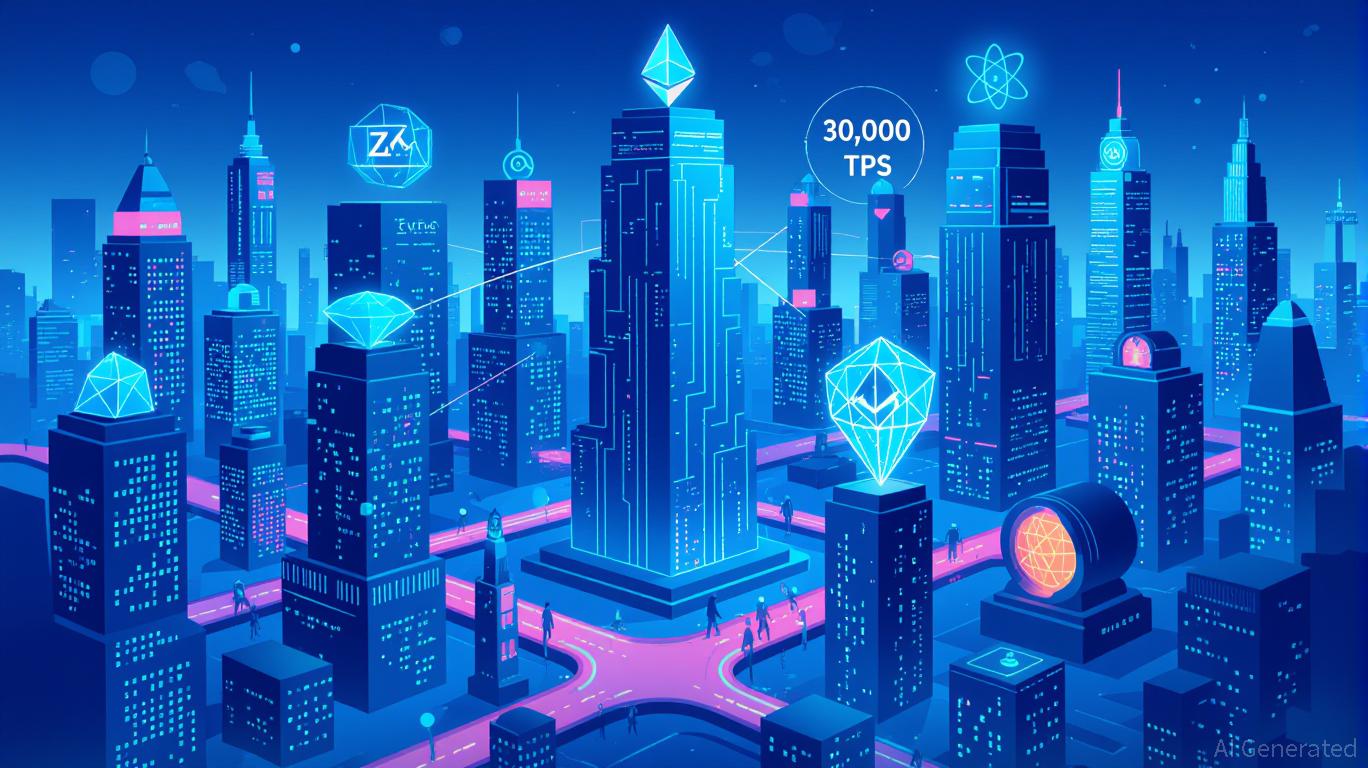
- ZKsync’s 2025 Atlas Upgrade achieves 15,000–43,000 TPS with $0.0001/transaction costs, boosting blockchain scalability for institutions. - Deutsche Bank , Sony , and Citi adopt ZKsync for tokenized assets and privacy-driven transactions, citing compliance and efficiency gains. - Market forecasts predict 60.7% CAGR for ZK Layer-2 solutions through 2031, with Fusaka upgrade targeting 30,000 TPS to solidify ZKsync’s leadership.
Hinge’s latest AI tool assists singles in skipping dull introductory conversations

Trending news
MoreCrypto prices
More





