U.S. August Core PCE Data Set for Release: A Key Test for the Fed’s Interest Rate Path
The U.S. Bureau of Economic Analysis (BEA) will release August data on personal income, personal spending, and the Personal Consumption Expenditures (PCE) Price Index on Wednesday, September 30. The release will also include the third estimate of second-quarter U.S. GDP. The PCE data is scheduled to be published at 8:30 a.m. Eastern Time.
As the Federal Reserve’s preferred inflation gauge, the PCE Price Index will directly shape market expectations for the future path of interest rates. Following the release, the U.S. dollar, Treasury yields, XAUUSD gold, and major U.S. stock indices could experience significant volatility.
After the Fed’s recent rate hike, markets are closely assessing whether inflation is continuing to move toward the central bank’s 2% long-term target or showing signs of renewed acceleration. This PCE report will be an important reference point in determining whether the Fed still needs to maintain a restrictive policy stance.
July Inflation Remained Above Target, Putting August Data in Focus
In July, the headline PCE Price Index rose 3.7% year over year, while the Core PCE Price Index increased 3.3% year over year. Although both measures declined from previous highs, they remained notably above the Federal Reserve’s 2% long-term inflation target.
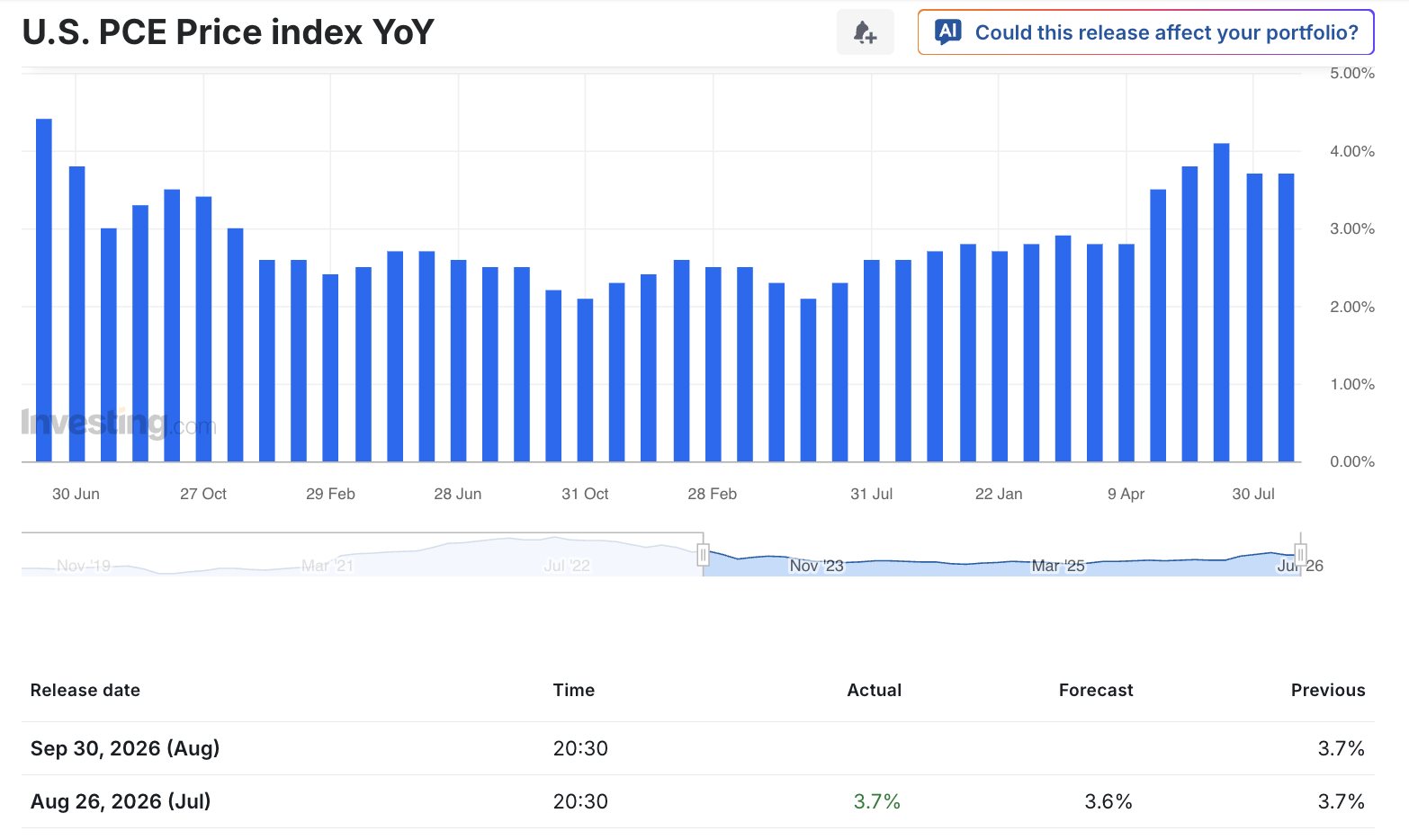
On a monthly basis, both headline PCE and Core PCE increased by 0.2% in July, suggesting that the pace of disinflation has not been entirely consistent. Markets are paying particular attention to Core PCE because it excludes more volatile food and energy components, providing a clearer indication of underlying inflationary pressures and trends in consumer service prices.
Markets currently expect headline PCE to rise by 0.4% month over month in August, while Core PCE is expected to increase by 0.3%. If there are no significant revisions to historical data, headline PCE inflation could rise to around 3.8% year over year, while Core PCE inflation may edge higher to approximately 3.4%.
If core inflation continues to accelerate, it would suggest that U.S. price pressures are more persistent than markets had anticipated. This could also push the Federal Reserve to maintain a more hawkish policy stance in upcoming meetings.
Three Key Areas for Markets to Watch
1. Whether Core PCE Continues to Accelerate
Core PCE will be the central focus of this report. If both the monthly and annual readings come in above market expectations, investors may interpret the data as evidence that inflationary pressures have not eased sufficiently. This could increase the likelihood of another Fed rate hike or delay expectations for future rate cuts.
Conversely, if Core PCE comes in below expectations, particularly if monthly growth slows meaningfully, it could reinforce confidence that inflation is moderating and support expectations for a more accommodative monetary-policy outlook.
2. Personal Income and Personal Spending
In addition to inflation figures, personal income and personal spending will also be closely watched. Consumer spending is a major driver of U.S. economic growth. If personal spending remains strong, it would indicate that demand is still supported, but it could also suggest continued pressure on service prices and core inflation.
If income growth slows and consumer spending weakens, markets may become increasingly concerned that high interest rates are restraining household demand and broader economic activity. This could help ease inflation, but it may also raise the risk of an economic slowdown.
3. Historical Revisions and the Final GDP Estimate
This release will coincide with an annual update to the National Economic Accounts, covering historical data for GDP, personal income, consumption, and inflation. Therefore, markets should not focus solely on August’s figures but should also monitor whether prior data is revised materially higher or lower.
Upward revisions to past inflation data could indicate that U.S. price pressures were stronger than previously understood, potentially supporting the U.S. dollar and Treasury yields. On the other hand, downward revisions to consumption and inflation data could strengthen expectations for economic cooling and a potential policy pivot.
How Could PCE Data Affect Gold and Stock Indices?
If Core PCE and personal spending both exceed expectations, markets may raise expectations that the Federal Reserve will keep interest rates elevated for longer or even deliver another rate hike. Under this scenario, Treasury yields and the U.S. dollar could strengthen, potentially putting short-term pressure on XAUUSD gold.
For stock indices, strong consumer spending can support expectations for corporate revenue and economic growth. However, if markets expect interest rates to remain elevated for longer, high-valuation technology stocks and growth-oriented sectors may face valuation pressure, potentially increasing volatility in major U.S. stock indices.
Conversely, if Core PCE falls below market expectations and personal spending points to slowing consumer momentum, markets may increase bets on a more accommodative Fed policy stance. The U.S. dollar and Treasury yields could decline, while gold may find support.
However, if consumer data is excessively weak, the stock market may not necessarily benefit immediately, as traders could also become concerned about the outlook for U.S. economic growth. As a result, market reactions should be assessed through the combined signals from inflation, spending, and GDP revisions rather than a single indicator alone.
Be Aware of Market Volatility Following the PCE Release
PCE is a key reference point for the Federal Reserve’s monetary-policy decisions. When the data is released, XAUUSD, the U.S. Dollar Index, U.S. Treasuries, and major stock indices may experience rapid price movements.
In addition to comparing the actual figures with market expectations, traders should monitor whether revisions to prior data, personal spending figures, and GDP updates send a consistent message alongside the inflation data. If the report delivers conflicting signals—for example, elevated inflation alongside sharply weaker consumption—markets may initially experience heightened volatility before a clearer direction emerges.
In a high-volatility trading environment, traders should manage leverage, position sizes, and stop-loss settings carefully. Avoid taking excessive risks by chasing the initial price movements immediately after the release.
Capture PCE Market Opportunities: Trade XAUUSD and Stock Index CFDs on Bitget
With U.S. PCE inflation data approaching, gold, the U.S. dollar, and U.S. stock index markets may present important volatility-driven trading opportunities. Through Bitget, traders can monitor and trade XAUUSD Gold and major U.S. stock index CFDs, responding flexibly to market movements driven by inflation data, interest-rate expectations, and broader macroeconomic developments.
All trading education provided by Bitget is for educational purposes only and should not be considered financial advice. The strategies and examples shared are for reference only and may not reflect actual market conditions. CFD trading involves significant risk, including the potential loss of capital. Past performance does not guarantee future results. Please conduct thorough research and ensure that you understand the risks involved. Bitget is not responsible for any trading decisions made by users.


- July Inflation Remained Above Target, Putting August Data in Focus
- Three Key Areas for Markets to Watch
- How Could PCE Data Affect Gold and Stock Indices?
- Be Aware of Market Volatility Following the PCE Release
- Capture PCE Market Opportunities: Trade XAUUSD and Stock Index CFDs on Bitget