
The Growing Impact of Artificial Intelligence on Learning and Professional Development
- Global AI in education market to grow from $7.57B in 2025 to $32.27B by 2030 (31.2% CAGR), driven by classroom AI adoption and workforce training. - Asia-Pacific leads growth (35.3% CAGR), with 60% U.S. teachers and 86% global students using AI for personalized learning and content summarization. - Institutions like Farmingdale State College pioneer AI integration through interdisciplinary programs and NSF-funded ethical AI research initiatives. - Strategic partnerships (e.g., IBM-Pearson) and platforms
AI’s Expanding Role in Education: Market Growth and Global Trends
The landscape of education is being fundamentally reshaped by artificial intelligence, with rapid adoption and significant financial backing fueling this evolution. Recent projections indicate that the global AI in education sector will soar from $7.57 billion in 2025 to an impressive $32.27 billion by 2030, reflecting a robust annual growth rate of 31.2%. This momentum is largely attributed to the widespread implementation of AI solutions in both classroom settings and professional training environments. Notably, 60% of teachers in the United States and 86% of students worldwide are already utilizing AI for activities such as content summarization and personalized instruction. The Asia-Pacific region stands out as a leader, boasting a remarkable 35.3% annual growth rate, which highlights the surging demand for AI-powered educational tools across the globe.
Investment Trends and Industry Shifts
Recent funding surges in AI-driven educational platforms underscore the sector’s vast potential. In 2025 alone, enterprise spending on AI reached $37 billion—more than tripling the previous year’s figure. Currently, AI accounts for 6% of the global Software-as-a-Service (SaaS) market. This expansion is not limited to consumer applications; businesses are increasingly backing startups that focus on adaptive learning and intelligent tutoring systems. A notable example is the partnership between IBM and Pearson, which leverages technologies like watsonx Orchestrate and watsonx Governance to develop advanced learning solutions tailored to the evolving needs of the workforce. Such collaborations are essential for bridging skills gaps in economies increasingly shaped by AI, as highlighted in the Stanford HAI 2025 AI Index Report, which points to AI’s transformative impact across sectors including healthcare and transportation.

Institutional Innovation: The Example of Farmingdale State College
Farmingdale State College (FSC) exemplifies how academic institutions can successfully weave AI into both their curricula and workforce development initiatives. The school’s Bachelor of Science in Artificial Intelligence Management (AIM) is a multidisciplinary program that merges technical know-how with business acumen. Courses such as AIM 301 and AIM 310 provide students with practical machine learning skills applicable to real-world business scenarios, while classes like STS 380 and STS 391 encourage thoughtful consideration of AI’s broader societal effects.
FSC’s commitment to innovation is further demonstrated by its investments in infrastructure. The forthcoming $75 million Center for Computer Sciences is expected to double enrollment in technology-related programs, directly addressing shortages in fields like AI, cybersecurity, and software engineering. Additionally, a research initiative funded by the National Science Foundation and led by Assistant Professors Nur Dean and Xiaojin Ye is exploring how AI can enhance students’ critical thinking in programming through the Socratic Metacognitive Inquiry-based Learning Environment (SMILE). This project not only advances educational methods but also aligns with the institution’s focus on ethical AI integration.
Assessing Long-Term Investment Opportunities
The enduring success of AI-powered educational platforms depends on their capacity to meet the evolving needs of both academia and industry. For investors, the most promising opportunities lie in solutions that are both scalable and adaptable. Companies such as 360Learning and Docebo, which provide AI-based tools for adaptive learning and workforce reskilling, are at the forefront of this movement. Meanwhile, institutions like FSC illustrate that effective AI adoption requires more than just technology—it demands interdisciplinary programs, strong industry partnerships, and a commitment to ethical standards.
Nonetheless, the sector faces ongoing challenges. Issues surrounding academic integrity persist, with a third of students reportedly accused of excessive reliance on AI tools. However, initiatives like FSC’s SMILE project demonstrate that AI can also promote independent thinking rather than dependence, emphasizing the need for platforms that balance innovation with accountability.
Looking Ahead: The Future of AI in Education
The intersection of AI, education, and workforce training presents a significant opportunity for forward-thinking investment. As the market continues to outpace traditional sectors and institutions like FSC lead the way with interdisciplinary AI programs, the educational technology field is set for substantial transformation. Investors who focus on platforms that address skill shortages, uphold ethical considerations, and offer scalable solutions—such as the IBM-Pearson alliance or FSC’s AIM initiative—will be well-positioned to benefit from a market projected to reach $32.27 billion by 2030. As AI continues to redefine how we learn and work, the emphasis must remain on empowering both learners and organizations to thrive in an increasingly AI-driven world.
Disclaimer: The content of this article solely reflects the author's opinion and does not represent the platform in any capacity. This article is not intended to serve as a reference for making investment decisions.
You may also like
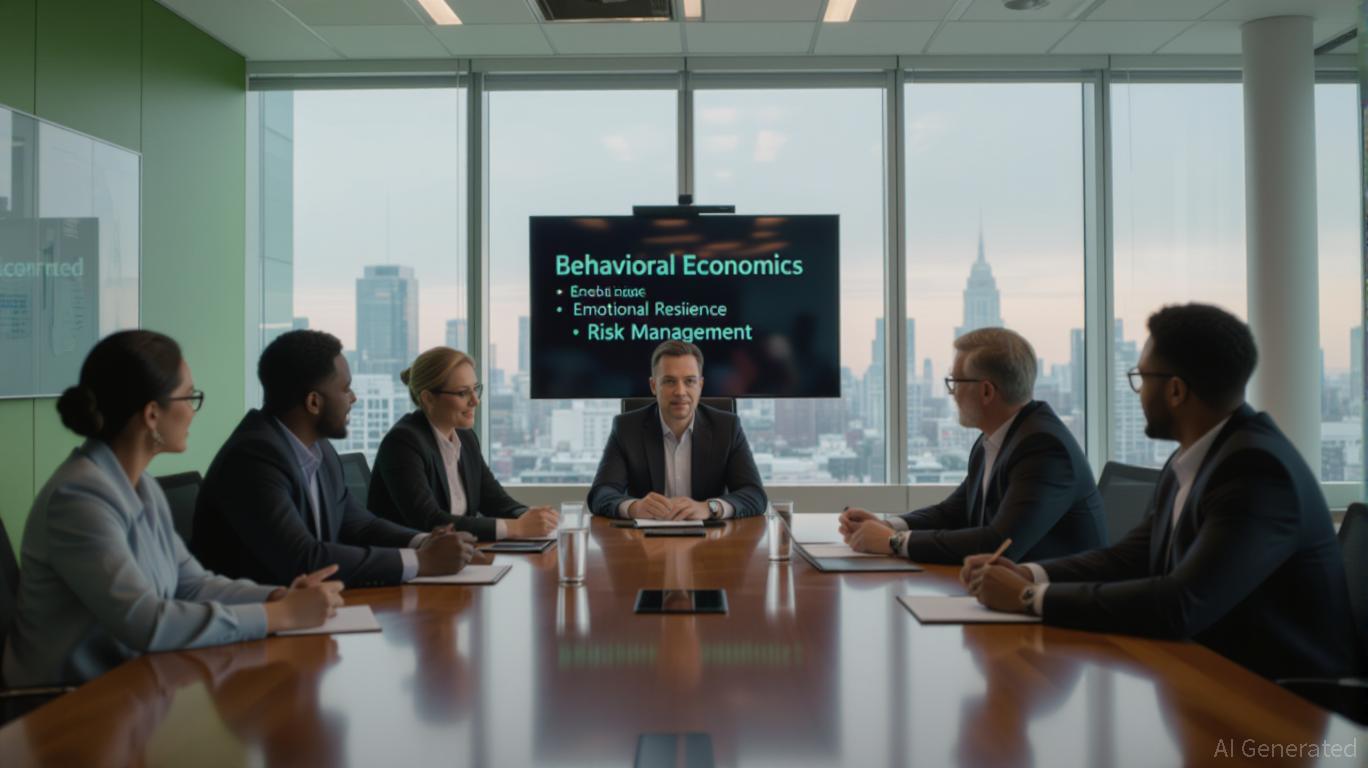
The Financial Wellness Aspect: The Influence of Investor Actions on Market Results
- Behavioral economics integrates psychology to explain how emotional, intellectual, and environmental wellness shape investor decisions and market outcomes. - Emotional resilience reduces cognitive biases like loss aversion, while intellectual engagement through AI tools improves long-term investment returns according to 2024-2025 studies. - Environmental factors such as ESG frameworks and workplace wellness programs demonstrate measurable economic benefits, including 20% higher productivity and reduced f
Regulatory Changes in U.S. Agriculture: The Impact of USDA Policy Decisions on Long-Term Investments in Livestock and Poultry Industries
- USDA’s 2023–2025 Organic Livestock and Poultry Standards (OLPS) impose stricter animal welfare rules, with phased compliance until 2029 to ease small producers’ adjustments. - Compliance costs for organic producers are high initially but projected to yield $59.1–$78.1 million annual benefits via enhanced consumer trust and premium pricing. - Investors favor scalable, tech-driven operations amid OLPS-driven capital shifts, though small producers face compliance challenges and market exit risks in poultry

ZK Atlas Enhancement: Marking a Milestone for Scalable Blockchain Frameworks
- ZKsync's 2025 Atlas Upgrade revolutionizes blockchain with 43,000 TPS, $0.0001 per-transaction costs, and sub-second finality via Airbender zkVM. - Modular EVM compatibility attracts Deutsche Bank , Sony , and $15B institutional investment, accelerating DeFi, NFTs, and cross-border payments. - ZK rollups' TVL surges to $28B, with 60.7% CAGR projected through 2031, driven by Bitcoin ETF inflows and $7.59B ZKP market growth by 2033. - Regulatory clarity under U.S. GENIUS Act and EU MiCA accelerates adoptio

ZK (Zero-Knowledge) Technology and Its Rapidly Growing Market Attention
- Zero-knowledge (ZK) technology is revolutionizing blockchain and fintech by enabling scalable, private, and compliant systems, with the ZKP market projected to grow from $1.535B in 2025 to $7.585B by 2033 at 22.1% CAGR. - Institutional adoption by firms like Goldman Sachs , Walmart , and HSBC highlights ZK's role in confidential transactions and supply chain transparency, supported by regulatory frameworks like the U.S. GENIUS Act and EU MiCA. - Enterprise platforms (Quorum, Hyperledger Fabric-X) and inn

Trending news
MoreCrypto prices
More





