Source: Wallstreetcn
The Federal Reserve once again cut rates at a regular pace as the market expected, but revealed the biggest internal split among voting policymakers in six years, suggesting a slower pace of action next year and possibly no action in the near term. As Wall Street insiders anticipated, the Fed also launched reserve management, deciding to buy short-term Treasuries at year-end to address pressure in the money market.
On Wednesday, December 10, Eastern Time, after the FOMC meeting, the Federal Reserve announced that the target range for the federal funds rate would be lowered from 3.75%-4.00% to 3.50%-3.75%. This is the third 25 basis point rate cut this year. Notably, the Fed's rate decision faced three dissenting votes for the first time since 2019.
The dot plot released after the meeting showed that the Fed policymakers' rate path forecast was consistent with the dot plot released three months ago, still projecting one 25 basis point rate cut next year. This means that the pace of rate cuts next year will slow significantly compared to this year.
By the close on Tuesday, CME tools showed that the futures market expected an almost 88% probability of a 25 basis point rate cut this week, while the probability of another 25 basis point cut would not reach 71% until June next year. The probability of such a cut at the meetings in January, March, and April next year did not exceed 50%.
The above CME tool forecast can be summarized by the recently popular term "hawkish rate cut." This means that the Fed will cut rates this time but also signals a possible pause in action, with no further cuts in the near term.
Nick Timiraos, a senior Fed reporter known as the "new Fed news agency," wrote after the Fed meeting that the Fed "hinted that it may not cut rates again for the time being," because there is a "rare" internal split over whether inflation or the labor market is more concerning.
Timiraos pointed out that three officials opposed the 25 basis point rate cut at this meeting, and the stagnation of inflation decline and cooling labor market made this meeting the most divided in recent years.
At the post-meeting press conference, Powell emphasized that he does not believe "the next move will be a rate hike" is anyone's baseline assumption.The current rate level allows the Fed to wait patiently and observe how the economy evolves next. He also said that currently available data indicate the economic outlook has not changed, and the scale of Treasury purchases may remain high in the coming months.
01 The Fed cuts rates by 25 basis points as expected, still projects one rate cut next year, launches RMP to buy $40 billion in short-term Treasuries
On Wednesday, December 10, Eastern Time, after the FOMC meeting, the Federal Reserve announced that the target range for the federal funds rate would be lowered from 3.75%-4.00% to 3.50%-3.75%. This marks the third consecutive FOMC meeting with a 25 basis point rate cut, totaling 75 basis points this year, and a cumulative 175 basis points since the easing cycle began in September last year.
Notably, the Fed's rate decision faced three dissenting votes for the first time since 2019. Governor Milan, appointed by Trump, continued to advocate for a 50 basis point cut, two regional Fed presidents and four non-voting members supported holding steady, and a total of seven opposed the decision, reportedly the largest split in 37 years.
The main change in this meeting's statement compared to the last is in the rate guidance. Although a rate cut was decided, the statement no longer generally says that the FOMC will assess future data, ongoing changes in the outlook, and risk balance when considering further cuts, but instead more clearly considers the "magnitude and timing" of rate cuts. The statement now says:
"In considering the magnitude and timing of further adjustments to the target range for the federal funds rate, the (FOMC) Committee will carefully assess the latest data, evolving (economic) outlook, and risk balance."
The statement reiterated that inflation remains slightly elevated and that downside risks to employment have increased in recent months, removing the phrase "unemployment rate remains low" and noting a slight rise as of September.
The statement added consideration of the "magnitude and timing" of further rate cuts, seen as raising the threshold for further cuts.
Another important change in this meeting's statement is the addition of a paragraph specifically noting the purchase of short-term Treasuries to maintain ample reserves in the banking system. The statement reads:
"The (FOMC) Committee judges that reserve balances have declined to an ample level and will begin purchasing short-term Treasuries as needed to maintain ample reserve supply."
This is equivalent to announcing the launch of so-called reserve management to rebuild liquidity buffers in the money market. Market turmoil often occurs at year-end, as banks typically reduce repo market activity at year-end to support balance sheets for regulatory and tax settlements.
The statement said reserves have declined to an ample level, and to maintain ample reserves, short-term Treasuries will be purchased starting this Friday. The New York Fed plans to buy $40 billion in short-term Treasuries over the next 30 days, and RMP short-term Treasury purchases are expected to remain high in the first quarter of next year.
The median rate forecast released by Fed officials after Wednesday's meeting was exactly the same as the last forecast released in September.
Fed officials currently also expect that after three rate cuts this year, there will be one 25 basis point rate cut each in the next two years.
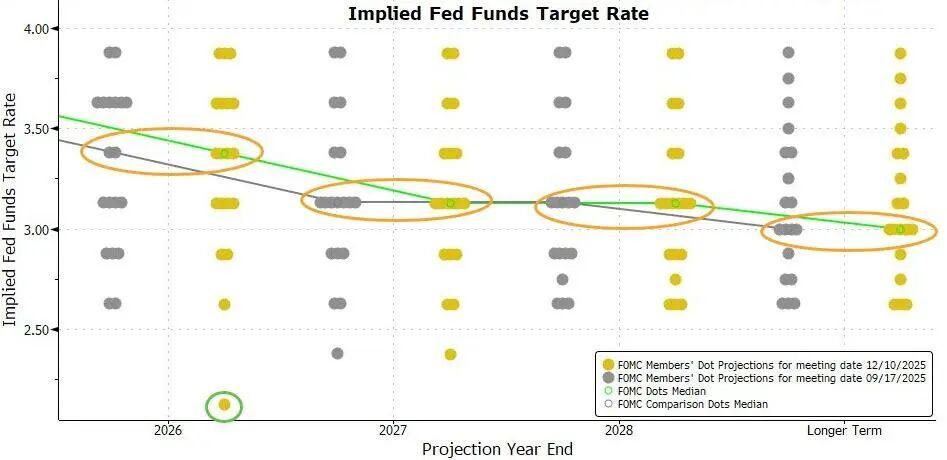
Previously, many expected that the future rate changes reflected in the dot plot would show Fed officials leaning more hawkish. This time, the dot plot was actually more dovish compared to last time.
Among the 19 Fed officials providing forecasts, seven now expect rates to be between 3.5% and 4.0% next year, compared to eight last time. This means that one fewer person expects no rate cut next year compared to last time.
The economic outlook released after the meeting showed that Fed officials raised their GDP growth forecasts for this year and the next three years, and slightly lowered the unemployment rate forecast for 2027, i.e., the year after next, by 0.1 percentage points, with unemployment rate forecasts for other years unchanged. This adjustment shows that the Fed believes the labor market is more resilient.
At the same time, Fed officials slightly lowered their PCE inflation and core PCE inflation forecasts for this year and next year by 0.1 percentage points each. This reflects a slightly increased confidence in inflation slowing in the near future.
02 Powell: Current rate level allows patience, does not believe "next move will be a hike" is anyone's baseline assumption
With today's rate cut, the Fed has cut policy rates by a total of 75 basis points over the past three meetings. Powell said this will help gradually bring inflation back to 2% as the impact of tariffs fades.
He said that the adjustments to policy stance since September have brought policy rates within the range of various "neutral rate" estimates, and the median forecast of FOMC members shows that the appropriate level for the federal funds rate at the end of 2026 is 3.4%, and 3.1% at the end of 2027, unchanged from September.
Powell said that currently, inflation risks are tilted to the upside, while employment risks are tilted to the downside, which is a challenging situation.
A reasonable baseline judgment is that the impact of tariffs on inflation will be relatively short-lived, essentially a one-time upward shift in the price level. Our responsibility is to ensure that this one-time price increase does not turn into a persistent inflation problem. At the same time, downside risks to employment have increased in recent months, and the overall risk balance has changed. Our policy framework requires balancing both sides of the dual mandate. Therefore, we believe it is appropriate to lower policy rates by 25 basis points at this meeting.
As progress on inflation moderation has stalled, Fed officials had already hinted before this week's decision that further rate cuts may require evidence of labor market weakness. Powell said at the press conference:
"Where we are now allows us to wait patiently and observe how the economy evolves next."
In the Q&A session, when asked whether the current policy rate is closer to neutral and whether the next move will necessarily be downward, or if policy risks have truly become two-way, Powell replied that no one currently assumes a rate hike as the baseline, and he has not heard such views. There are different opinions within the committee: some members believe the current policy stance is appropriate and advocate holding steady and observing further; others believe another rate cut may be needed this year or next, possibly more than once.
When committee members write down their judgments on the policy path and appropriate rate levels, expectations mainly focus on a few scenarios: either maintaining the current level, making a small rate cut, or a slightly larger rate cut. Powell emphasized that the mainstream expectation does not include a rate hike scenario.
Powell said that as an independent decision, the Fed also decided to start purchasing short-term US Treasuries, with the sole purpose of maintaining ample reserves over a longer period, so that the Fed can effectively control policy rates. He stressed that these issues are separate from the stance of monetary policy itself and do not represent a change in policy direction.
He said that the scale of short-term Treasury purchases may remain high in the coming months, and the Fed is not strictly "concerned" about tightness in the money market, but the situation has developed a bit faster than expected.
Powell also said that according to the statement released by the New York Fed, the initial scale of asset purchases will reach $40 billion in the first month and may remain high in the following months to ease the expected short-term money market pressure. After that, the purchase scale is expected to decline, with the specific pace depending on market conditions.
In terms of the labor market, Powell said that although official employment data for October and November have not yet been released, existing evidence shows that layoffs and hiring activity remain at low levels. At the same time, households' views on job opportunities and businesses' perceptions of hiring difficulty are both declining. The unemployment rate continues to rise slightly, reaching 4.4%, and job growth has slowed significantly compared to earlier this year. At the same time, the Fed's statement no longer uses the phrase "unemployment rate remains low."
Powell said in the subsequent Q&A session that after adjusting for overestimation in employment data, job growth may have turned slightly negative since April.