
Bitcoin Price Rally During Macroeconomic Instability: Investor Confidence and Institutional Integration in the Fourth Quarter of 2025
- Bitcoin surged 86.76% in Q4 2025 amid macroeconomic uncertainty, driven by institutional adoption and regulatory clarity. - 86% of institutional investors now allocate to crypto, with $1.65T market cap supported by 65% institutional demand via ETFs/ETPs. - Macroeconomic factors like inflation hedging and MMT-driven valuation models reshaped Bitcoin's role as a store of value. - Supply-demand imbalances and $4T potential institutional demand outpace Bitcoin's limited supply, creating upward price pressure
Bitcoin’s Q4 2025 Rally: Institutional Momentum and Macroeconomic Forces
In the final quarter of 2025, Bitcoin’s price movement has surpassed typical market predictions, climbing sharply despite widespread economic uncertainty. This remarkable 86.76% increase late in the year can be attributed to a unique blend of growing institutional participation, clearer regulatory guidelines, and the evolution of valuation strategies. As investors worldwide contend with inflation and changing monetary policies, Bitcoin’s reputation as both a hedge and an alternative investment has reached new heights. This overview examines the macroeconomic and institutional factors transforming Bitcoin’s valuation, providing guidance for those seeking to position themselves in the digital asset space.
Institutional Involvement: Establishing Credibility
By 2025, institutional engagement with Bitcoin has reached unprecedented levels. Research from SSGA indicates that 86% of institutional investors are either already involved with digital assets or intend to allocate funds to them this year. This shift is largely due to Bitcoin’s integration into mainstream finance through regulated products such as spot ETFs and ETPs. The introduction of spot Bitcoin ETFs in both the U.S. and Europe during 2024 and 2025 has helped legitimize Bitcoin as a portfolio diversifier, with institutional investors now accounting for 65% of its $1.65 trillion market capitalization.
Major financial entities are leading this trend. BlackRock’s IBIT ETF has exceeded $50 billion in assets under management, while JPMorgan has begun utilizing blockchain technology for payment solutions. Corporate treasuries now control 3.5% of Bitcoin’s circulating supply, underscoring persistent institutional demand. Recent regulatory advances, including the U.S. GENIUS Act and CLARITY Act, have further reduced legal uncertainties, opening the door to $100 trillion in global institutional capital.
Macroeconomic Influences: Inflation Protection and Policy Shifts
Bitcoin’s appeal in late 2025 is closely tied to global economic trends. As central banks confront inflation and persistently low yields, Bitcoin has emerged as a preferred safeguard against currency depreciation. Grayscale reports that investors increasingly view Bitcoin as a reliable store of value during times of geopolitical instability. The adoption of Modern Monetary Theory (MMT) has also influenced how institutions assess Bitcoin’s worth, with fiscal policy now taking precedence over monetary tightening.
MMT’s focus on government spending has prompted institutions to seek assets resilient to inflation. By 2025, more than half of hedge funds have incorporated digital assets into their strategies, and firms like MicroStrategy and BlackRock are using Bitcoin to counterbalance underperforming traditional investments. The Federal Reserve’s ongoing rate cuts, expected to continue into 2026, enhance Bitcoin’s attractiveness as liquidity from money market funds—currently totaling $43 trillion—may increasingly flow into cryptocurrencies.
Valuation Approaches: Institutional Logic and Supply Constraints
Bitcoin’s valuation is shifting away from speculative cycles toward models favored by institutional investors. The imbalance between limited supply and rising demand is a key factor: if just 2–3% of global assets are allocated to crypto, institutional demand could reach $4 trillion, far exceeding Bitcoin’s available supply. With only 77 billion in new supply projected over the next six years, upward price pressure appears inevitable.
Bitcoin’s utility is also expanding beyond speculation. The rise of tokenized real-world assets and stablecoin infrastructure has increased its use in cross-border payments and decentralized finance. Corporate treasuries, such as MicroStrategy’s $4.6 billion Bitcoin acquisition in 2024, highlight its strategic importance. Analysts at NYDIG note that the entry of major banks like Citi and U.S. Bank into the Bitcoin market marks a significant shift in asset allocation strategies.
Market Trends and Analyst Insights
Even after experiencing a 32% correction in late 2025, Bitcoin’s underlying fundamentals remain strong. Indicators such as heightened put option skew and a decrease in Coin Days Destroyed point to a potential market bottom. Both Coinbase and Glassnode maintain a cautiously optimistic outlook for the remainder of the year. The liquidity crunch in October 2025, which saw $19 billion liquidated on decentralized exchanges, exposed certain vulnerabilities but also prompted improvements in institutional risk management.
Expert forecasts continue to highlight Bitcoin’s long-term promise. Standard Chartered projects a year-end price of $200,000, while NYDIG suggests a possible $750,000 scenario if adoption accelerates. These projections depend on ongoing regulatory advancements, including the Biden administration’s crypto policies, and the continued development of secure custody solutions.
Investor Strategies for the New Era

For investors, the dramatic rise in Q4 2025 signals Bitcoin’s evolution from a speculative asset to a core institutional holding. To navigate this changing landscape, consider the following approaches:
- Utilize regulated investment vehicles such as IBIT and ETPs to participate in Bitcoin’s growth while managing volatility.
- Balance Bitcoin’s inflation-resistant qualities with traditional assets to achieve optimal risk-adjusted returns.
- Take advantage of the ongoing supply-demand imbalance and the momentum of institutional adoption, which could fuel long-term appreciation.
Final Thoughts
The surge in Bitcoin’s price during Q4 2025 is a direct result of broader economic changes and growing institutional acceptance. As regulatory frameworks solidify, valuation models evolve, and corporate adoption increases, Bitcoin’s place in the global financial system is becoming more secure. For investors, the key challenge is to manage short-term volatility while aligning with the powerful, long-term trends shaping the digital asset landscape. Amid ongoing economic uncertainty, Bitcoin stands out as a compelling option for strategic investment.
Disclaimer: The content of this article solely reflects the author's opinion and does not represent the platform in any capacity. This article is not intended to serve as a reference for making investment decisions.
You may also like
Solana’s Uptake Among Institutions and Recent Market Fluctuations: Reasons to Trust in Its Long-Term Potential
- Solana secures institutional validation via JPMorgan's $50M Solana-based commercial paper and Bhutan's gold-backed TER token, signaling cross-sector adoption. - Technical upgrades like Firedancer and consensus algorithm enhancements boost scalability, outpacing Ethereum while maintaining cost efficiency and sustainability. - Q2 2025 revenue ($271M) and $7.14B trading volume post-Bhutan deal highlight Solana's market dominance despite $130–$145 short-term volatility amid macroeconomic uncertainty. - JPMor

BrightView’s Approach to Growth in the Changing Landscaping Industry: Harnessing Infrastructure and Sustainable Practices
- BrightView leverages infrastructure and sustainability to lead the evolving landscaping sector. - Its 2025 initiatives include smart irrigation (30% water savings) and 17% electric fleet expansion, aligning with UN SDGs and SASB standards. - IoT/AI tools boost efficiency, while 2025 EBITDA rose 8.5% to $352. 3M , supporting $300M fleet upgrades and $150M share buybacks. - Client diversification (83% retention) and niche markets (e.g., solar-powered senior living) strengthen market reach and client loyalt

Retirement Preparation and Portfolio Longevity for Wealthy Individuals: Harmonizing Emotional Preparedness with Financial Stability
- High-net-worth individuals (HNWIs) face a critical gap between financial preparedness (92% with advisors) and emotional readiness (11% deemed ready by advisors) for retirement. - Studies reveal 74% of HNWIs work with advisors, yet 49% admit their financial planning needs improvement, highlighting misaligned confidence and actual preparedness. - Portfolio sustainability strategies like diversified alternative assets (10% CAGR) and tax-efficient tools (Roth conversions, annuities) address inflation risks w

LIR Life Sciences and the Transformation of Obesity Treatments Through Needleless Administration
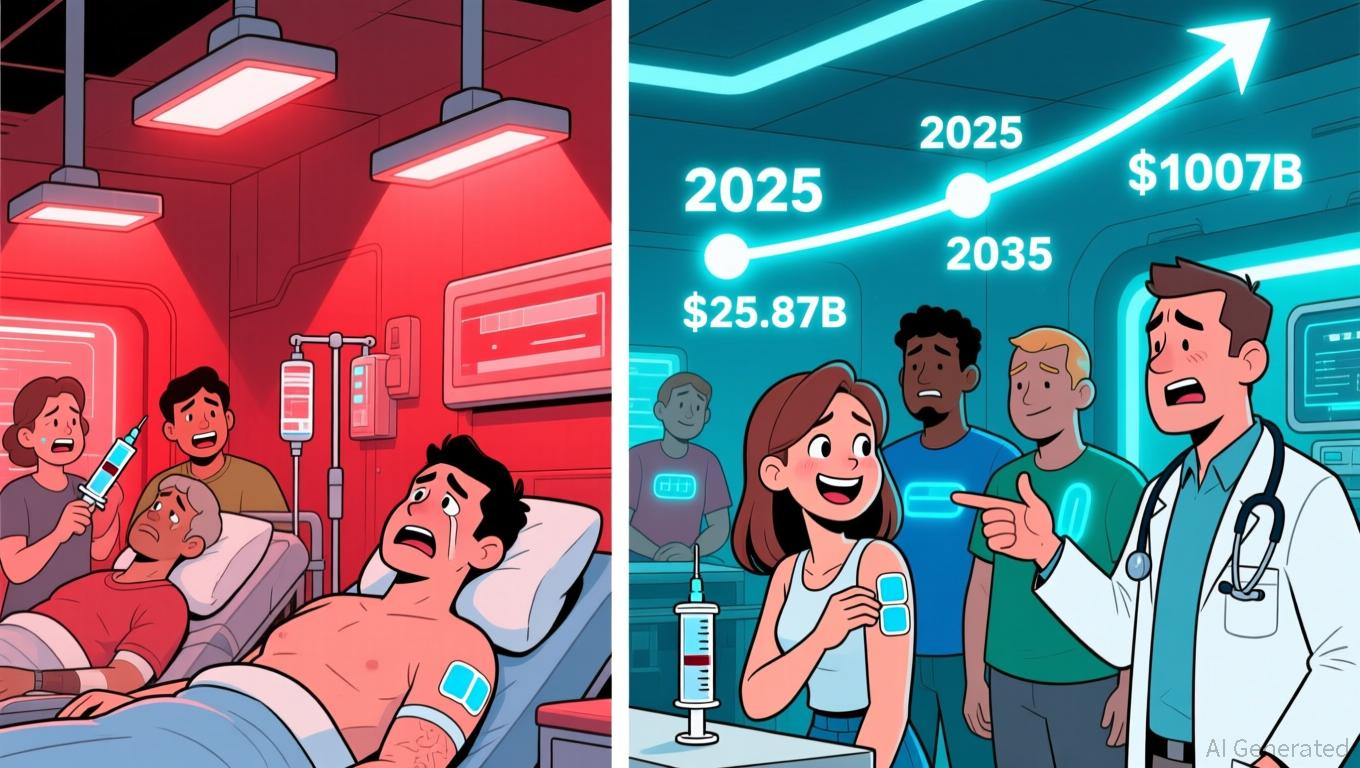
- Global obesity therapies market projected to reach $100B by 2035, driven by GLP-1 agonists and demand for non-invasive treatments. - LIR Life Sciences develops CPP-based transdermal delivery systems for GLP/GIP therapies, addressing patient adherence challenges in a $25.87B market. - Post-2025 acquisition by Blackbird, LIR pivoted to biopharma with $1M funding, but faces liquidity risks (-$32,388 net cash) despite 283.75% EBITA growth. - CPP technology enables needle-free delivery with injectable-like ef
Trending news
MoreCrypto prices
More





