
CRA targets 2,500 Dapper Labs users in NFT tax probe

Canada’s CRA won a court order forcing Dapper Labs to hand over data on 2,500 users, marking a major escalation in the country’s crypto tax enforcement drive.
- A Federal Court order compels Dapper Labs to share detailed information on 2,500 users after CRA narrowed an initial request covering about 18,000 accounts.
- CRA has recovered over C$100 million in unpaid crypto taxes since 2020, is creating a new financial crimes agency, and will adopt the OECD CARF in 2026.
- Canadian regulators, including FINTRAC, stepped up 2025 actions with major AML penalties on platforms like Cryptomus and KuCoin, tightening overall crypto compliance.
The Canada Revenue Agency has obtained a court order requiring Dapper Labs to provide detailed information on 2,500 platform users as part of an expanded investigation into undeclared cryptocurrency income, according to court documents filed in September 2025.
Canada Revenue Agency probes Dapper Labs users
The Federal Court order compels the Vancouver-based NFT platform to supply data on a specific group of customers, marking the country’s second major probe into crypto tax evasion. The CRA initially sought information on approximately 18,000 accounts but narrowed the request to 2,500 users following negotiations, according to agency statements.
Dapper Labs, known for NFT products including NBA Top Shot and CryptoKitties, has not been accused of any wrongdoing. The court order follows a precedent established in 2020 when the CRA obtained customer data from Toronto-based exchange Coinsquare.
The agency has recovered more than C$100 million in unpaid taxes related to cryptocurrency activity over the past three years, according to CRA figures. However, the agency has not secured a criminal conviction for crypto tax evasion since 2020, despite ongoing investigations.
Internal CRA estimates indicate that as many as 40% of users on certain platforms may be non-compliant with tax reporting requirements. Investigators have cited difficulties gathering evidence across multiple jurisdictions and decentralized platforms as obstacles to prosecution.
The federal government plans to establish a new financial crimes agency by spring 2026 to expand investigative capabilities and streamline data collection for digital-asset cases, according to government announcements.
Canada will implement the O ECD’s Crypto-Asset Reporting Framework beginning in 2026, requiring crypto-asset service providers to report customer identities, account balances, and transaction data annually to the CRA. The framework aligns Canada with other nations adopting enhanced disclosure requirements for digital-asset companies.
Canadian regulators have increased enforcement actions in 2025. FINTRAC , the country’s financial intelligence unit, imposed a C$176.96 million penalty on Cryptomus for anti-money-laundering violations and fined KuCoin C$19.5 million for similar breaches, according to FINTRAC statements.
The combination of court-ordered data requests, forthcoming CARF reporting requirements, and the planned financial crimes agency represents a significant expansion of Canada’s approach to cryptocurrency taxation and compliance.
Disclaimer: The content of this article solely reflects the author's opinion and does not represent the platform in any capacity. This article is not intended to serve as a reference for making investment decisions.
You may also like
Aster DEX's On-Chain Momentum: Signaling the Future of DeFi
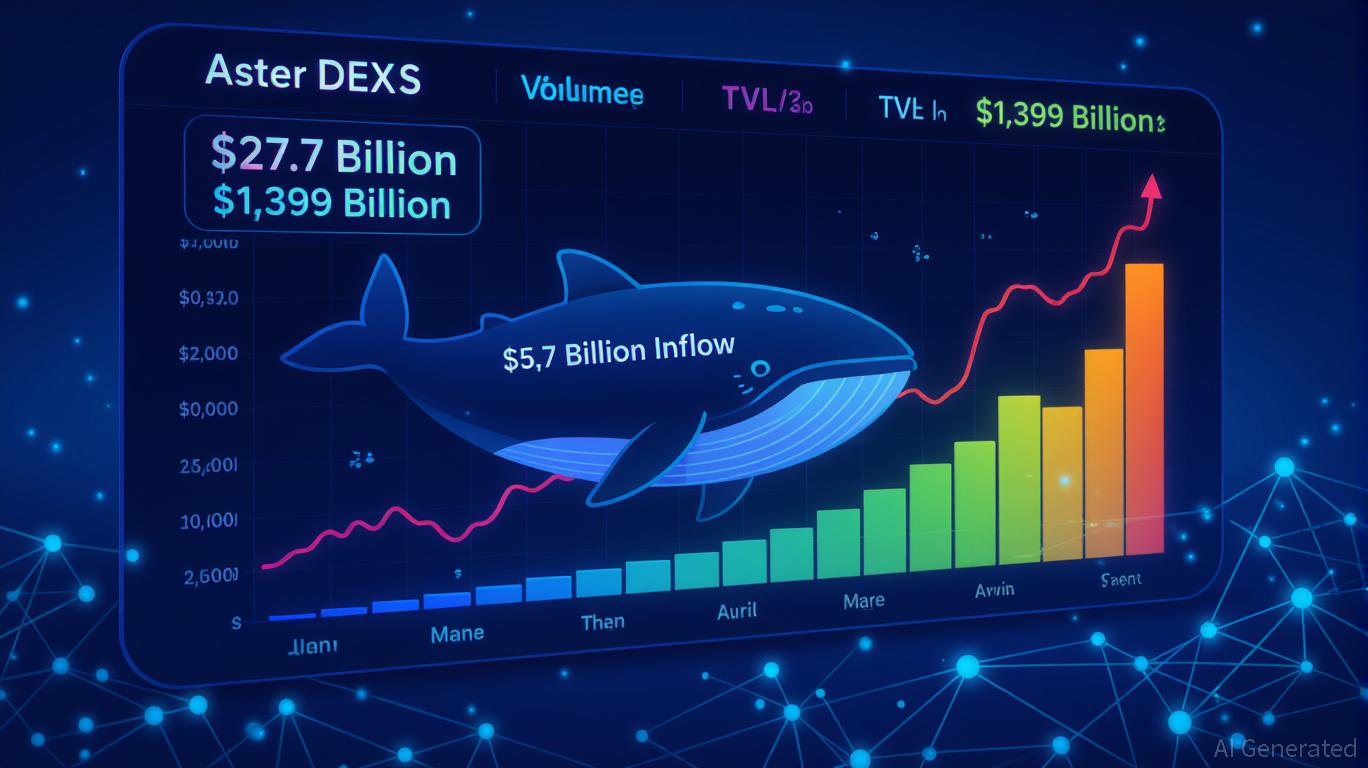
- Aster DEX reported $27.7B daily volume and $1.399B TVL in Q3 2025, outpacing DeFi benchmarks with 2M users. - Institutional whale activity, including CZ's $2M ASTER purchase, drove $5.7B inflows and 800% volume spikes. - Hybrid AMM-CEX model and ZKP privacy tech enabled 40.2% TVL growth, 77% private transactions, and 19.3% perpetual DEX market share. - ASTER's margin trading upgrades and Stage 4 airdrops fueled 30% price surges, while Aster Chain's 2026 launch will integrate privacy-preserving ZKPs. - On
Astar (ASTR) Price Rally: Protocol Enhancements and Ecosystem Growth Drive Long-Term Value
- Astar (ASTR) surged 150% due to protocol upgrades and ecosystem expansion, positioning it as a sustainable value creation case study in blockchain. - Tokenomics 3.0 (fixed 10.5B supply) and Burndrop mechanism created deflationary incentives, supported by Galaxy Digital's $3. 3M OTC investment and Astar's $29.15M buyback. - Cross-chain interoperability with Polkadot/Plaza and Sony's Soneium, plus partnerships with Toyota and Japan Airlines, expanded real-world utility in logistics, identity, and loyalty p

Astar 2.0 Debut and Tokenomics Revamp: Driving DeFi Innovation and Attracting Institutional Participation
- Astar Network's Astar 2.0 introduces Tokenomics 3.0 with fixed 10.5B ASTR supply and 5% annual burn rate to stabilize value for institutional investors. - The update features Burndrop mechanism, asynchronous cross-chain security, and ESG-aligned protocols to address regulatory risks and attract traditional capital. - Plaza platform enables seamless asset transfers across Ethereum , BSC, and Polkadot , while zkEVM scalability targets 300,000 TPS by 2026 for enterprise-grade DeFi solutions. - Governance sh

PNC Bank launches Bitcoin trading for high-net-worth clients
Trending news
MoreCrypto prices
More





