
Citadel Securities Turns Against DeFi While Pouring $500 Million into Ripple

Citadel Securities has taken a dual stance in crypto, publicly opposing regulatory exemptions for decentralized finance (DeFi) while co-leading a $500 million investment in Ripple. The move highlights a growing divide between institutional support for compliant blockchain infrastructure and skepticism toward fully decentralized protocols. Citadel’s Push Against DeFi Loopholes Citadel Securities submitted a formal letter
Citadel Securities has taken a dual stance in crypto, publicly opposing regulatory exemptions for decentralized finance (DeFi) while co-leading a $500 million investment in Ripple.
The move highlights a growing divide between institutional support for compliant blockchain infrastructure and skepticism toward fully decentralized protocols.
Citadel’s Push Against DeFi Loopholes
Citadel Securities submitted a formal letter to the SEC on December 2, 2025. In the letter, the capital markets firm opposes carve-outs for DeFi platforms trading tokenized US equities.
The firm argued that decentralized platforms must adhere to existing investor protections. The letter raises concerns about transparency, anti-money laundering (AML) and know-your-customer (KYC) compliance, market controls, and custody standards.
“Exempting DeFi from oversight could endanger investors and the broader market,” the letter warned, urging consistent regulation across all trading venues, centralized or blockchain-based.
The stance drew criticism from crypto advocates. The Blockchain Association warned that applying traditional rules to open-source protocols could stifle innovation.
This debate mirrors historical SEC conflicts, such as those between former Chairman Gary Gensler, who favored strict enforcement, and Commissioner Hester Peirce, who often dissented, advocating for regulatory flexibility.
Despite its public opposition to DeFi exemptions, Citadel co-led a $500 million funding round for Ripple.
The investment values Ripple at $40 billion, signaling confidence in its regulated, compliance-focused infrastructure. Other participants included Pantera Capital, Galaxy Digital, Brevan Howard, and Marshall Wace.
Swell 2025: We have closed a $500 million strategic investment at a $40 billion valuation, led by Fortress Investment Group and Citadel Securities: → $95B+ in total Ripple Payments payment volume→ $1B+ $RLUSD stablecoin market cap→ 6 strategic…
— Ripple (@Ripple) November 5, 2025
Ripple has expanded aggressively in the institutional market. It acquired six firms in two years, including Hidden Road (rebranded as Ripple Prime) for $1.25 billion. Hidden Road now serves 300 institutions and processes $3 trillion in annual transactions.
Additional acquisitions, like GTreasury ($1 billion) and Rail ($200 million), strengthened Ripple’s custody, settlement, and treasury services.
The firm’s RLUSD stablecoin has surpassed $1 billion in market cap, and a recent 25% share buyback reflects its financial discipline.
Ripple now holds 75 global licenses and has processed $95 billion in payments, positioning itself as a bridge between traditional finance and blockchain.
Market Reaction and Implications
Despite the institutional backing, XRP fell almost 10% to $2.17 following the investment announcement, reflecting investor uncertainty about its immediate utility.
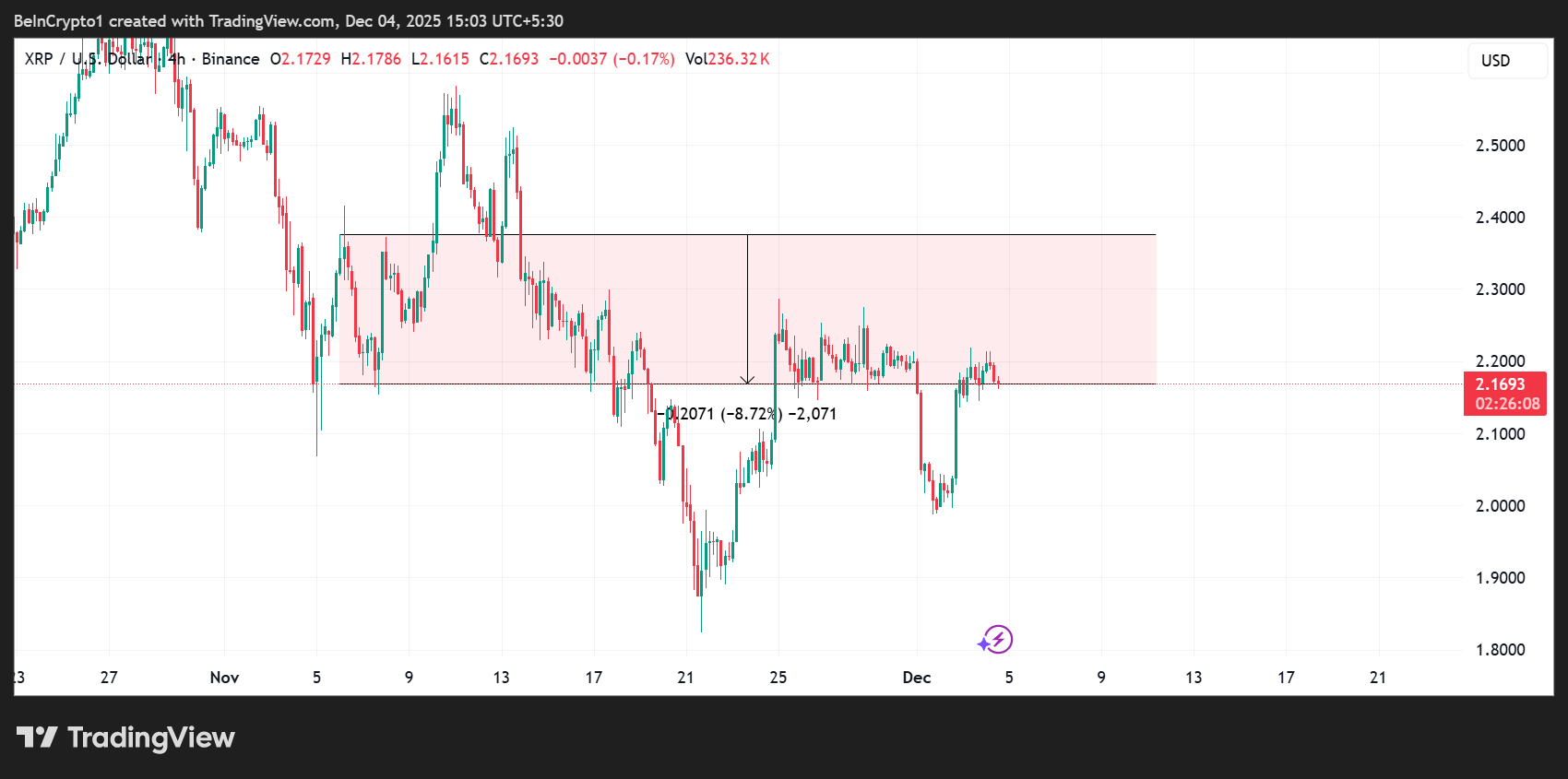 Ripple (XRP) Price Performance. Source:
The contrast between Citadel’s public regulatory advocacy and private market bets highlights a broader trend. Institutions prefer blockchain projects that operate within regulated frameworks rather than fully permissionless systems.
As regulations improve, capital is increasingly flowing toward compliant blockchain solutions, reinforcing investor protections while maintaining innovation.
Citadel’s moves signal that regulatory clarity is now a prerequisite for large-scale institutional adoption, even if it diverges from the ethos of DeFi.
Disclaimer: The content of this article solely reflects the author's opinion and does not represent the platform in any capacity. This article is not intended to serve as a reference for making investment decisions.
You may also like
Anthropology and Innovation: Leveraging Cultural Understanding to Propel Technological and Business Advancement
- Anthropology bridges human-technology gaps by decoding cultural patterns in AI, business, and education. - Ethnographic methods enhance product design (e.g., Intel , Adidas) and reduce AI implementation risks via cultural alignment. - Anthropology-driven corporate training boosts ROI 2-3x in cross-cultural communication and diversity initiatives. - Venture capital increasingly uses "predictive anthropology" to forecast markets, though "impact washing" risks persist. - Cross-disciplinary integration of an

AI-Powered Token Fluctuations: Insights Gained from the ChainOpera AI Token Downturn
- ChainOpera AI's COAI token collapsed 90% in late 2025 due to hyper-centralized supply, governance flaws, and regulatory ambiguity. - The crash triggered market instability, exposing vulnerabilities in AI-driven crypto ecosystems reliant on speculative hype rather than intrinsic value. - Anthropological insights and interdisciplinary models like CAVM are proposed to improve governance and valuation frameworks for decentralized AI projects. - Structural safeguards including diversified token supply, hybrid

MMT Token's Latest Price Jump: Temporary Hype or Genuine Breakthrough?
- MMT token surged 1,330% post-Binance listing in late 2025 but fell 37.37% over 30 days amid crypto market weakness. - Market analysis highlights oversold RSI-7 (19.23) and weak buying interest, while Bitcoin dominance rose to 58.13%. - MMT launched buybacks and a perpetual futures DEX to stabilize value, but top 100 holders control 20.4% of circulating supply. - Experts note speculative GME-like retail frenzy alongside DeFi utility, predicting 2025 price range of $0.4342-$0.8212.

Stripe and Paradigm’s Payments-Focused Blockchain Tempo Launches Public Testnet

Trending news
MoreCrypto prices
More





