
XRP News Today: XRP ETFs Draw $643 Million in Investments, Yet Price Fails to Surpass $2.60 Barrier
- XRP approaches critical monthly close amid $643M ETF inflows driven by Grayscale, Franklin Templeton, and Bitwise, capturing 0.5% of its market cap. - Despite institutional demand, XRP struggles to break $2.60 as whale offloads and derivatives open interest drop 1.7B, creating short-term selling pressure. - Analysts highlight 0.5 Fibonacci and 21-month EMA as key technical thresholds, with 21Shares' upcoming ETF adding liquidity uncertainty amid mixed RSI/MACD signals. - Sustained ETF inflows and institu
XRP Faces Pivotal Moment Amid Surging ETF Interest
XRP is at a crucial crossroads as it nears an important monthly close, with institutional appetite for XRP exchange-traded funds (ETFs) accelerating even as market turbulence persists. According to SoSoValue, XRP ETFs attracted $643.92 million in net inflows during their first month, representing 0.5% of the token’s total market value. This surge has been fueled by major players such as Grayscale, Franklin Templeton, Bitwise, and Canary, whose combined efforts have pushed ETF-held XRP above half a percent of the circulating supply—an early sign of significant institutional involvement.
These inflows reflect a broader shift in institutional strategies. As highlighted by Xaif on X, daily net inflows have reached $164 million, with total ETF assets now exceeding $628 million, pointing to swift adoption by large investors.
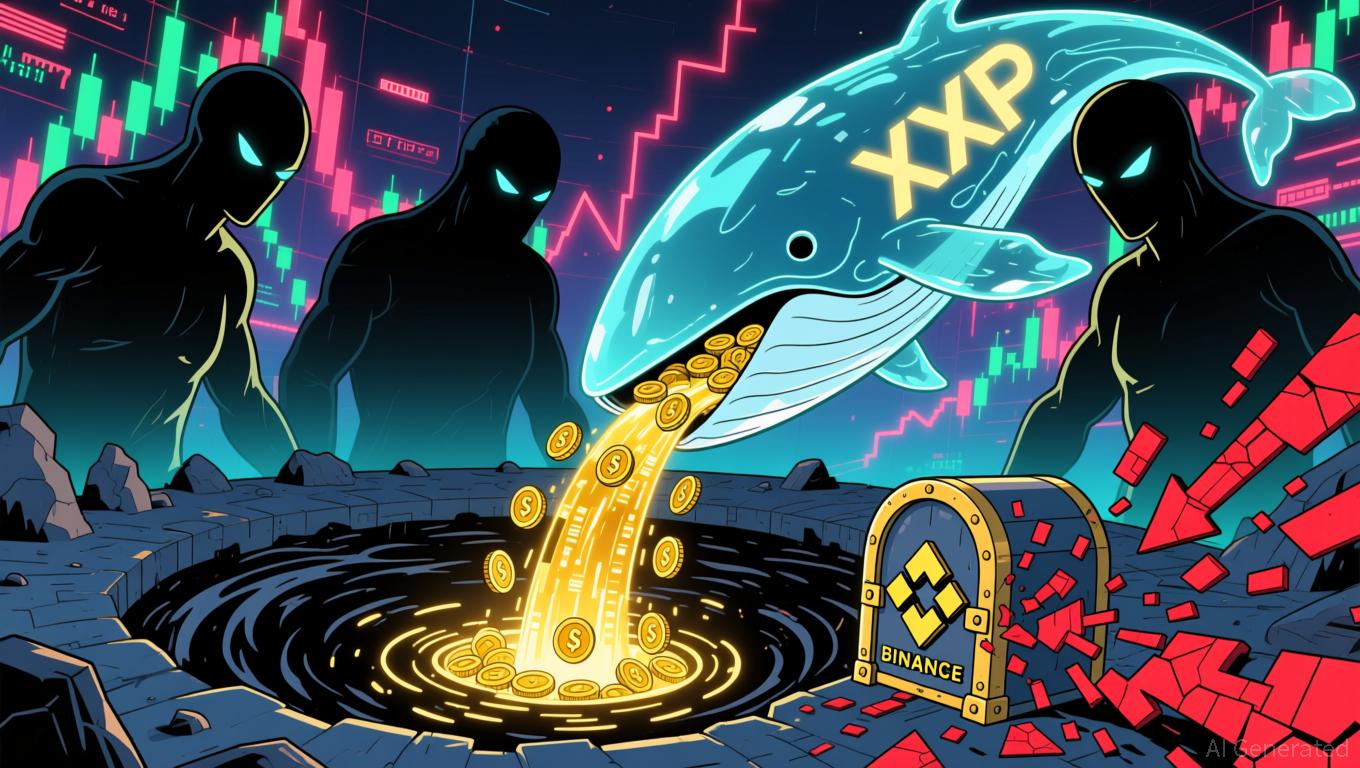
Despite this influx of institutional capital, XRP’s price has shown mixed performance, hovering near $2.20 even after record-breaking ETF launches. Notably, Franklin Templeton’s XRPZ and Grayscale’s GXRP saw a combined $164 million in opening-day investments, yet this failed to sustain upward price momentum. Meanwhile, derivatives markets reported a $1.7 billion decrease in open interest on Binance, and large holders, or “whales,” have reportedly sold off 180 million XRP tokens, adding to short-term selling pressure.
Analysts warn that while ETF inflows have tightened the available supply and heightened market tension, XRP’s ability to maintain crucial technical levels will be key in determining its short-term direction.
Key Technical Levels to Watch
- A monthly close above $2.60 would place XRP above the 0.5 Fibonacci retracement, signaling potential bullish momentum.
- A move past $3.40 could indicate a significant breakout.
- Conversely, closing below the 21-month EMA could threaten long-term support and investor confidence.
Analyst EGRAG Crypto has stressed the importance of these thresholds, noting that continued institutional inflows must offset recent whale sell-offs and unwinding of leveraged positions in derivatives to maintain a positive outlook.
Looking Ahead: New ETF Launches and Market Signals
The upcoming introduction of 21Shares’ XRP ETF adds further uncertainty. With institutional investments in XRP already totaling $666 million, this new product could bring additional liquidity to a market still wrestling with volatility. However, traders remain cautious: while ETF inflows point to growing institutional trust, technical indicators like the RSI and MACD remain neutral, suggesting the possibility of a consolidation period.
As XRP approaches its monthly close, the balance between institutional demand and underlying market fundamentals will be decisive. Continued strong inflows and successful ETF launches could strengthen XRP’s standing in regulated markets, but any breach of key support levels may prompt a reassessment of its long-term adoption prospects.
Disclaimer: The content of this article solely reflects the author's opinion and does not represent the platform in any capacity. This article is not intended to serve as a reference for making investment decisions.
You may also like
Blockchain’s $6.8 Billion Bet: Will Advancements Outpace Its Security Risks?
- Terminal Finance's collapse exposed blockchain fintech vulnerabilities from delayed tech adoption and security flaws, triggering sector-wide scrutiny. - Naver-Upbit's $6.8B AI-blockchain merger faces challenges after Upbit's $36M Solana breach, mirroring 2019 North Korean-linked attacks. - Balancer's $116M hack revealed systemic DeFi risks, with debates over audit efficacy despite 11 prior security reviews. - Binance's legal troubles and BNB's price slump highlight market skepticism, while initiatives li

Bitcoin News Update: Krugman Links Bitcoin's Decline to Waning 'Trump Trade' Hype
- Bitcoin's 30% drop from October peak linked to fading "Trump trade" speculation, per Nobel laureate Paul Krugman, who frames it as speculative rather than stable value. - BlackRock's IBIT ETF regained $3.2B profit post-$90K rebound, while SpaceX's $105M BTC transfer sparks custodial strategy debates amid market volatility. - Naver's $10B Dunamu acquisition and corporate Bitcoin treasury moves highlight institutional crypto integration, despite $19B industry selloff and regulatory challenges. - Prediction
Bitcoin News Today: "Conflicting Whale Strategies Cast Uncertainty on Bitcoin's Path to $100K"
- Bitcoin's drop below $100,000 coincided with mixed whale strategies, including accumulation, shorting, and exchange deposits, signaling uncertain market direction. - Ethereum whales used 16.08 million DAI to buy 5,343 ETH at $3,010, while Bitcoin whales deposited 9,000 BTC, potentially signaling selling preparation. - Derivatives markets showed conflicting bets, with a $91M BTC short and $36.4M long flip, while ETF inflows ($84M total) hinted at institutional confidence amid macroeconomic risks. - Analys

Exchanges Call on SEC: Deny Exemptions to Maintain Fairness in the Market
- WFE warns SEC against broad crypto exemptions for tokenized stocks, citing risks to investor protections and market integrity. - Tokenized stocks lack dividend rights, voting access, and custody frameworks, creating "mimicked products" with weaker safeguards. - SEC's sandbox-style exemptions risk regulatory arbitrage, allowing crypto platforms to bypass rules enforced on traditional exchanges. - Global bodies like IOSCO warn tokenization amplifies data integrity and custody risks, urging unified standard
Trending news
MoreCrypto prices
More





