
Switzerland Delays Crypto Tax Info Sharing Until 2027, Affecting Global Compliance Timeline

Quick Breakdown:
- The Swiss Federal Council officially approved the implementation of the OECD’s Crypto-Asset Reporting Framework (CARF).
- The new rules will require crypto service providers to begin collecting user data in 2026.
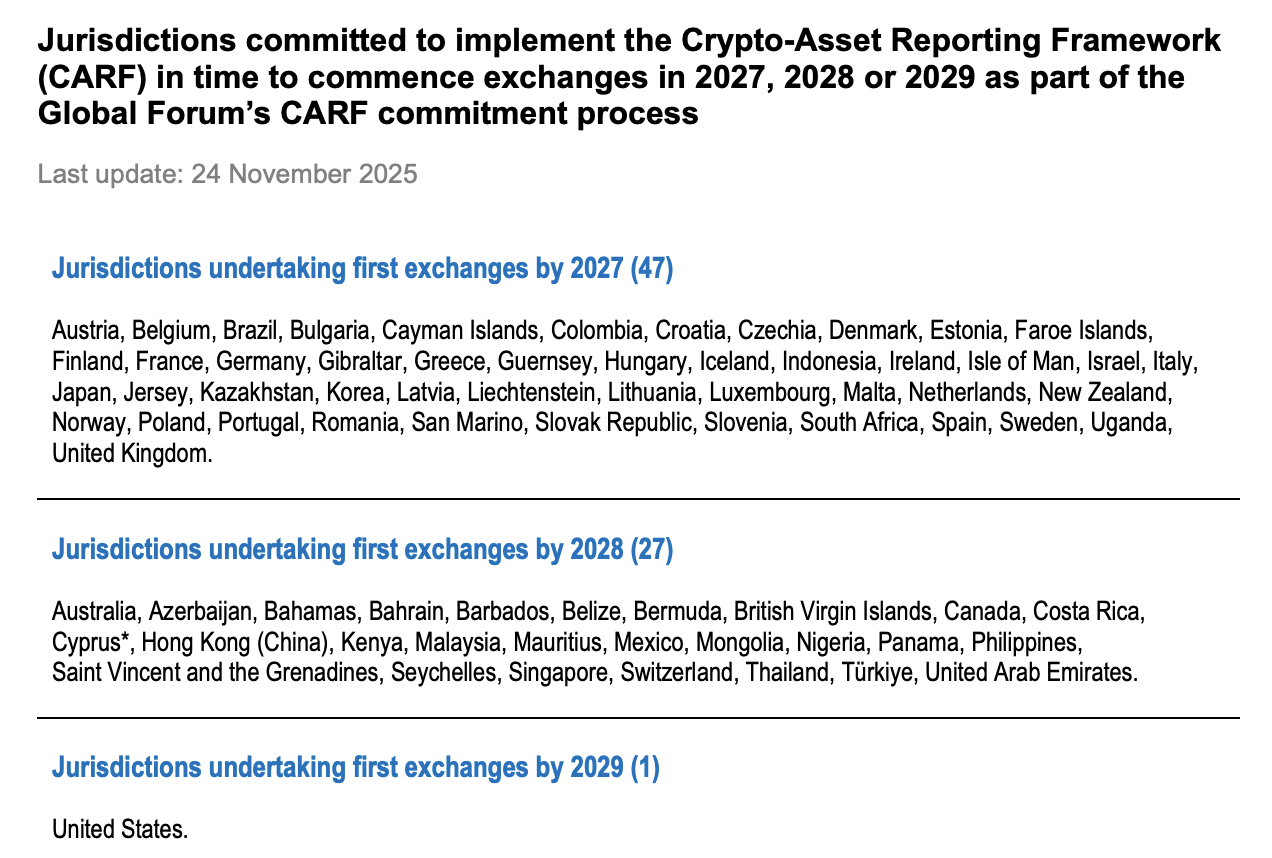
- The international exchange of tax information with 74 partner nations is scheduled to start in 2027, fulfilling the country’s commitment to global tax transparency.
Switzerland’s government has adopted a critical piece of international tax regulation for digital assets , signalling the end of the cryptocurrency market’s “Wild West” era in the neutral nation. The Swiss Federal Council approved significant updates to the country’s Automatic Exchange of Information (AEOI) Ordinance, including the introduction of the new Crypto-Asset Reporting Framework (CARF) developed by the Organisation for Economic Co-operation and Development (OECD).
Although the CARF’s legal framework is set to take effect in Switzerland on January 1, 2026, the automatic exchange of data with foreign tax authorities won’t begin until 2027. In practice, this means crypto service providers will need to register and carry out due diligence checks starting in 2026, but the information they collect during that first year won’t be shared until the following year.
The reporting framework aims to close tax loopholes
The move is part of a broader global effort to improve tax transparency and curb cross-border tax evasion involving digital assets. The aim is to close gaps in the current system and make sure crypto-assets are treated on par with traditional financial instruments.
Under the new rules, Reporting Crypto-Asset Service Providers (RCASPs), including exchanges, brokers, and certain wallet providers, will need to collect standard KYC information from their customers. They’ll also be required to submit annual reports to the Swiss Federal Tax Administration (FTA) detailing activity such as crypto-to-crypto trades, crypto-to- fiat transactions, and transfers.
The Swiss Parliament recently approved expanding the AEOI framework to include crypto-assets. Once fully rolled out, the exchange network will cover 74 partner jurisdictions, including all EU member states and most G20 nations. Some major economies, such as the United States, China, and Saudi Arabia, are not included for now because they haven’t fully adopted the OECD standard. The U.S., however, is expected to introduce its own version in 2027.
 Source
:
OECD
Source
:
OECD
Meanwhile, Switzerland-based FUTURE Holdings AG, focusing on institutional Bitcoin treasury and infrastructure, secured CHF 28 million in a major funding round led by Fulgur Ventures, Nakamoto, and TOBAM. This investment will expand its platform, aiming to establish Switzerland as Europe’s top hub for institutional Bitcoin finance by bridging Bitcoin with legacy finance for corporate and financial clients under stable regulation. The substantial rise highlights accelerating institutional adoption.
Take control of your crypto portfolio with MARKETS PRO, DeFi Planet’s suite of analytics tools.”
Disclaimer: The content of this article solely reflects the author's opinion and does not represent the platform in any capacity. This article is not intended to serve as a reference for making investment decisions.
You may also like
The Growing Significance of Financial Well-being in Investment Strategies
- Investors increasingly prioritize financial wellness, integrating emotional intelligence (EI), ESG principles, and fintech to align wealth strategies with holistic well-being and ethical values. - Research shows higher EI improves investment resilience, prompting advisors to address emotional biases like loss aversion through AI-driven tools and personalized guidance. - ESG-linked assets surpassed $50 trillion by 2025, with fintech platforms enabling tailored sustainable portfolios and AI-powered debt ma

COAI Experiences Significant Price Decline in Late November 2025: Is the Market Overreacting or Does This Present a Contrarian Investment Chance?
- ChainOpera AI (COAI) plummeted 90% in late 2025 due to CEO resignation, $116M losses, and regulatory ambiguity from the CLARITY Act. - Market panic and 88% supply concentration in top wallets amplified the selloff, while stablecoin collapses worsened liquidity risks. - Contrarians highlight C3 AI's 26% YoY revenue growth and potential 2026 regulatory clarity as signs of mispriced long-term AI/crypto opportunities. - Technical indicators suggest $22.44 as a critical resistance level, with analysts warning

Hyperliquid (HYPE) Price Rally: An In-Depth Look at Protocol Advancements and Liquidity Trends
- Hyperliquid's HYPE token surged 3.03% amid HIP-3 upgrades enabling permissionless perpetual markets and USDH stablecoin launch. - Protocol innovations boosted liquidity by 15% but failed to halt market share erosion to under 20% against competitors like Aster. - Structural challenges persist through token unstaking, unlocks, and OTC sales, yet HyENA's $50M 48-hour volume signaled renewed engagement. - Whale accumulation of $19.38M near $45-46 and HYPE buybacks aim to stabilize price, though long-term suc

Trending news
MoreCrypto prices
More





