
Legendary Name Gider Ayak, Who Surprisingly Announced His Departure from Ripple, Made Important Statements About XRP!

In early October, legendary name David Schwartz, who was among the founders of XRP, announced that he would resign from his position as Ripple CTO.
This decision came as a surprise to the XRP community, as Schwartz was among the key figures who played a key role in Ripple's current position.
Although Schwartz has only two months left before he leaves office, he continues to make important statements regarding XRP.
At this point, Ripple CTO David Schwartz announced that the company may sell the rights to buy XRP locked in massive escrow accounts.
Schwartz said that the 35 billion XRP held in Ripple's escrow account cannot be released into circulation until the scheduled monthly unlocks, but the company may sell or transfer the rights to receive XRP tokens to be unlocked in the future.
However, Schwartz highlighted a critical point. The prominent figure stated that these rights can only be sold by Ripple itself. In other words, the right to withdraw locked XRP cannot be transferred without Ripple's approval and authorization.
From a market perspective, these statements do not mean that Ripple will immediately release the locked XRP tokens or accelerate their circulation.
Schwartz made this statement during a community discussion that began after software engineer Vincent Van Code raised questions about how crypto data trackers report XRP's circulating supply compared to Bitcoin.
Van Code noted that tracking sources like CoinMarketCap exclude XRP held in Ripple's escrow accounts from market capitalization, but even include Bitcoin held in Satoshi's wallet in their calculations. According to Code, excluding the 1 million BTC held in Satoshi's wallet would reduce Bitcoin's market capitalization by approximately 15%.
At this point, the exclusion of locked tokens from XRP’s market capitalization calculation has fueled discussions that XRP’s market capitalization is understated compared to other cryptocurrencies.
As you may recall, Ripple CTO David Schwartz, one of the most well-known names in the cryptocurrency industry, announced at the beginning of October that he would be leaving his position at the end of the year, after more than 13 years.
Schwartz, who announced that he will step down as CTO at the end of the year, said he will focus on spending time with his family and returning to his long-delayed hobbies. However, Schwartz stated that he will not be leaving the XRP ecosystem entirely, saying, “Let me warn you, I am not walking away from the XRP community.”
Disclaimer: The content of this article solely reflects the author's opinion and does not represent the platform in any capacity. This article is not intended to serve as a reference for making investment decisions.
You may also like
Hyperliquid (HYPE) Price Fluctuations: Is This the Next Era for Decentralized Trading?
- Hyperliquid (HYPE) surged 23% to $56 in late 2025, driven by its hybrid CLOB model bridging DeFi and centralized trading. - Institutional confidence grew via 425,000 HYPE staked and HIP-3 fee cuts, enhancing liquidity and governance. - Token unlocks and $600M buybacks stabilized markets, though 3 manipulation incidents exposed liquidity risks. - Regulatory clarity (CLARITY Act/MiCA) and AI-driven upgrades position HYPE for $71–$86 by 2026–2028, pending macroeconomic shifts.

The Growing Enthusiasm for Hyperliquid and Cryptocurrency Derivatives
- Hyperliquid leads crypto derivatives shift via stablecoin integration and retail-friendly infrastructure, expanding access for SMBs and individual traders. - U.S. and India drive retail adoption with regulatory clarity and grassroots participation, as stablecoins dominate 93% of market liquidity. - Speculative trading risks rise amid 2025 market corrections and regulatory crackdowns, linking crypto behavior to gambling-like financial distress patterns. - Exchange innovation and academic interest in block

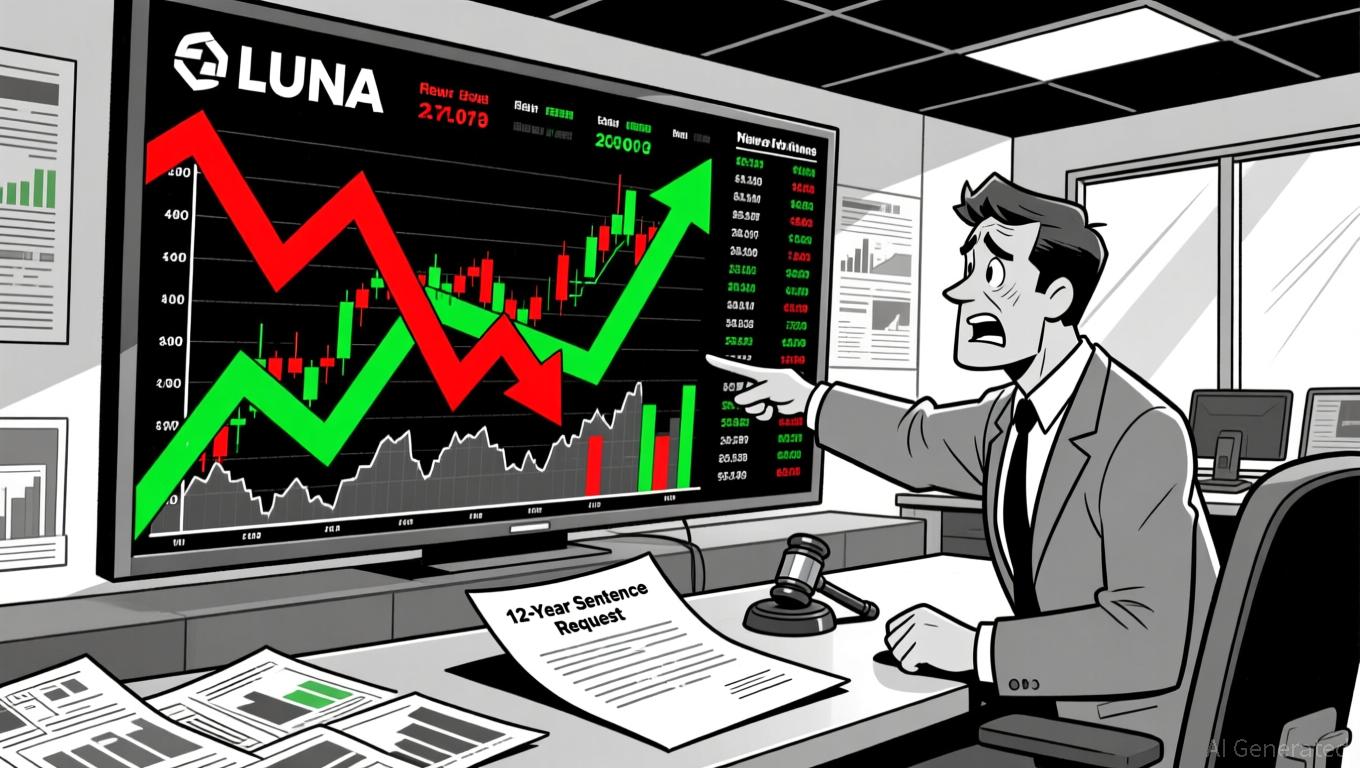
Luna Jumps 46.22% in a Week Following Legal Action Reports
- LUNA surged 5.67% in 24 hours, driven by prosecutors' 12-year prison request for Terra founder Do Kwon. - Kwon faces charges over TerraUSD's collapse, which erased $40B, with prosecutors calling his actions "colossal in scope." - Market reacted strongly: Luna Classic jumped 130% while LUNA rose 70% amid renewed Terra ecosystem interest. - Sentencing on Dec 11 could reshape Terra's future, with legal outcomes potentially influencing crypto regulatory frameworks. - Investors warned of persistent volatility
AI Token Price Fluctuations and Investor Prudence: Insights from the ChainOpera Collapse and Strategies for Building Resilience
- ChainOpera AI's 2025 collapse exposed systemic risks in centralized crypto projects with opaque AI models and governance. - The token lost 90% of value due to liquidity imbalances, unaudited algorithms, and regulatory uncertainty under the U.S. CLARITY Act. - Post-crash lessons emphasize transparent governance, real-world utility, and compliance with frameworks like NIST AI RMF and ISO/IEC 42001. - Projects like ASI and Ocean Protocol demonstrate resilience through decentralized models, auditable systems
Trending news
MoreCrypto prices
More





