
How Investors Stockpiled Stellar (XLM) Despite Falling Prices in October

While market sentiment around Stellar (XLM) stays bearish, on-chain data reveals quiet accumulation. Rising TVL, major exchange outflows, and network upgrades point to renewed investor conviction amid short-term price weakness.
The unexpected price decline of Stellar (XLM) in October boosted demand, even though the token has not yet recovered its previous losses. On-chain data and the project’s latest updates reflect confidence among certain investors, while overall market sentiment remains pessimistic.
Investor accumulation of XLM throughout October indicates long-term conviction rather than short-term price chasing. The following factors provide a clearer explanation.
Exchange Reserves Plunge While TVL Hits Record High
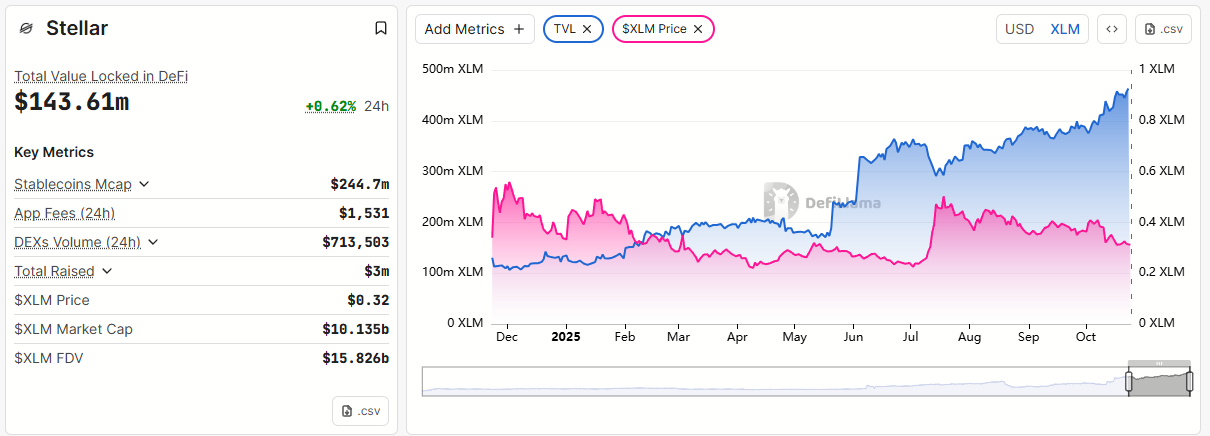
According to DeFiLlama, the total value locked (TVL) on the Stellar chain, measured in XLM, has surged to an all-time high of over 456 million XLM locked across various DeFi protocols.
 Stellar TVL. Source:
Comparing XLM’s price performance with its TVL since last December highlights investors’ faith in the network’s ecosystem.
Specifically, since December, XLM’s price has dropped by 50%, but the amount of XLM locked in DeFi protocols has increased more than fourfold.
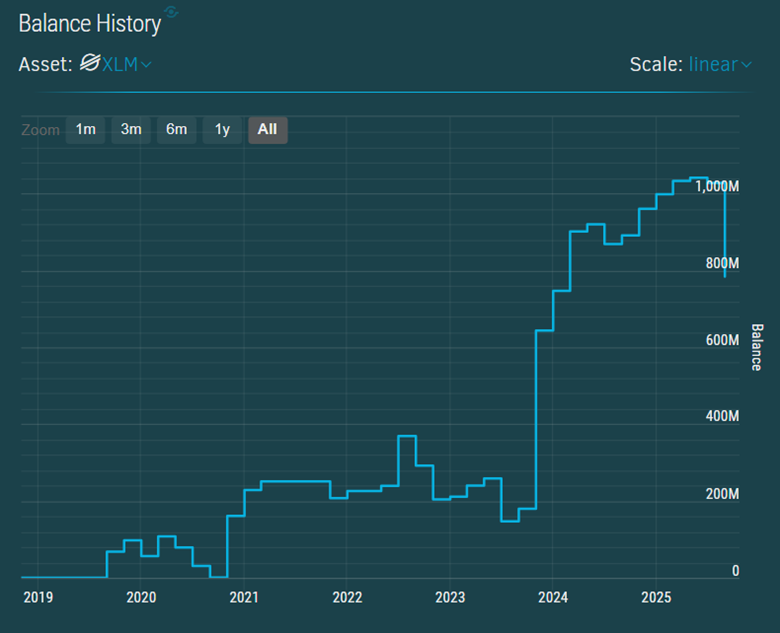
Another positive sign comes from Binance wallet data. The exchange’s official XLM address (GBA…GPA) recorded over 240 million XLM withdrawn from the exchange over the past two months, the largest outflow since 2024.
 XLM supply on Binance. Source:
Combining these two data points suggests that many XLM investors were heavily accumulating during October. They may have moved tokens off exchanges for long-term storage or to deploy them in DeFi.
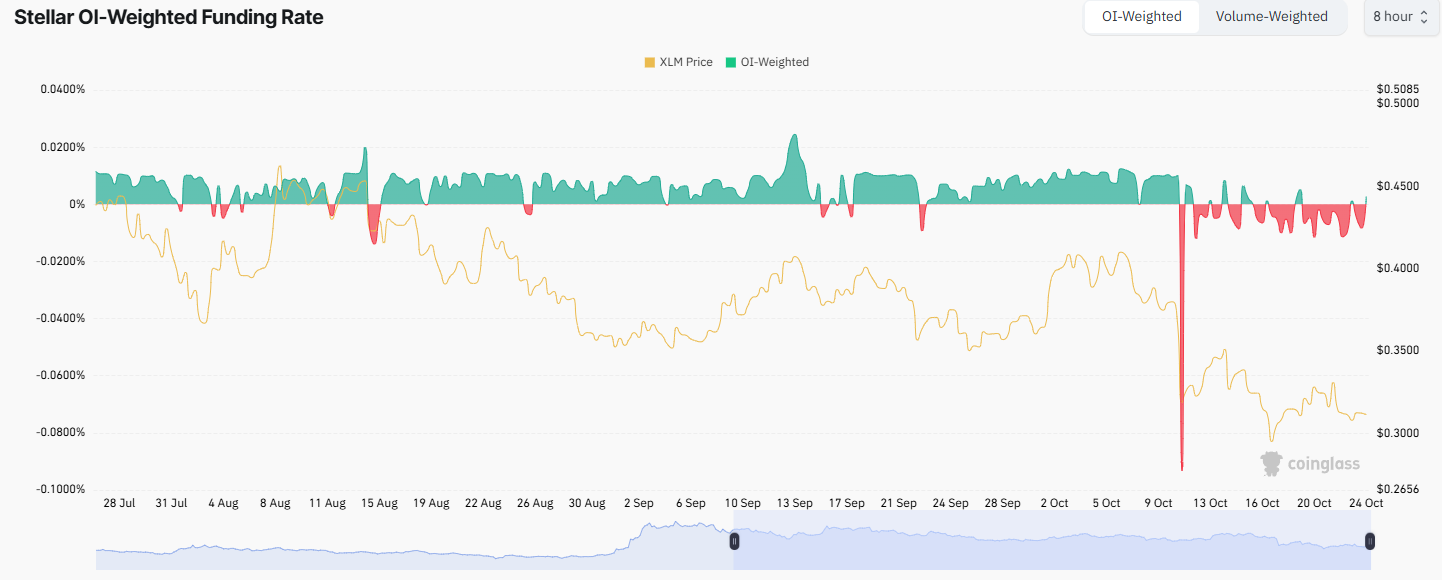
However, the overall picture is not entirely optimistic. Data from CoinGlass shows that the funding rate for XLM futures contracts has remained negative for the past two weeks, reflecting ongoing bearish sentiment among traders.
 Stellar (XLM) Funding Rate. Source:
The OI-weighted funding rate has fluctuated below zero since October 11, indicating that traders are paying to maintain short positions. The drop below $0.20 has made market sentiment even more pessimistic.
While the TVL and exchange reserve data suggest long-term optimism, the negative funding rate reveals short-term selling pressure on exchanges. As a result, XLM’s price could continue to fall. Yet, for some investors, that weakness presents an opportunity.
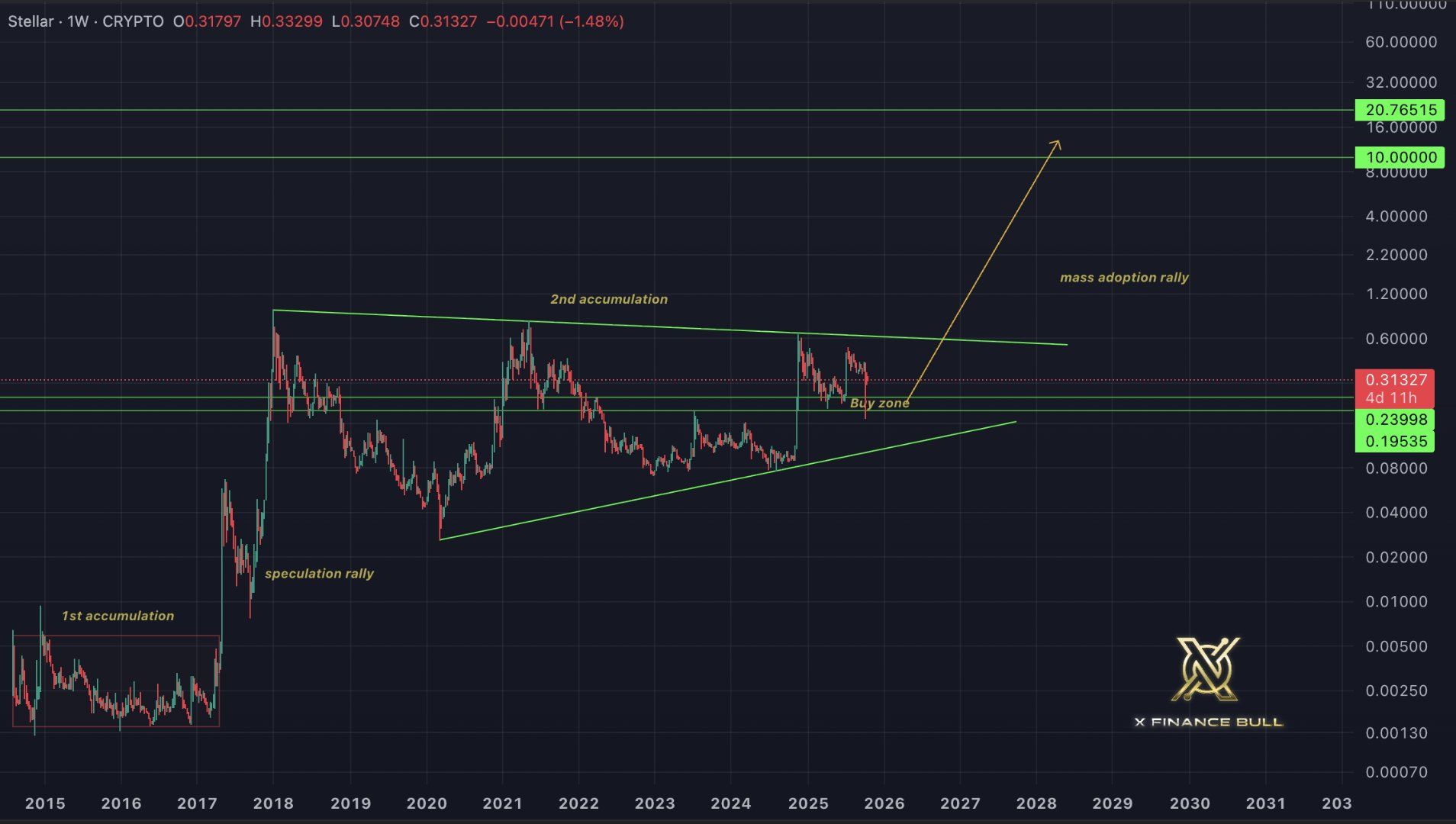
Several investors believe that XLM below $0.20 represents an attractive entry point before a potential bull run similar to 2017.
 XLM Price Prediction. Source:
“What’s coming next? The mass adoption rally — it’s written all over this chart. Two clean accumulation phases. Buy zone holding. The breakout won’t warn you,” investor X Finance Bull predicted.
Finally, Stellar’s vitality stems from its core upgrades and real-world use cases.
Validators on the Stellar network recently voted to upgrade the Stellar Mainnet to Protocol 24, fixing a bug in the state storage feature. At the same time, the value of real-world assets (RWA) on Stellar rose by 26.3% over the past month, reaching $638 million.
Disclaimer: The content of this article solely reflects the author's opinion and does not represent the platform in any capacity. This article is not intended to serve as a reference for making investment decisions.
You may also like
Astar 2.0’s Influence on AI Infrastructure and Cloud Computing Sectors: Evaluating Changes in AI Hardware Requirements and Emerging Investment Prospects
- Astar 2.0's blockchain innovations in cross-chain interoperability and scalability aim to reshape AI infrastructure by optimizing data flow and reducing latency. - Partnerships with Sony and Toyota demonstrate blockchain-enabled AI logistics applications, enhancing transparency and operational efficiency in supply chains. - Deflationary tokenomics and institutional adoption strategies position Astar to capitalize on AI hardware growth, with analysts projecting $0.80–$1.20 ASTR valuation by 2030. - The pl

ZK Technology Experiences Rapid Growth in 2025: Could This Mark a Turning Point for Web3?
- ZK technology is driving Web3 mainstream adoption in 2025 with scalability breakthroughs and institutional adoption. - ZK rollups now exceed $3.3B TVL, proving scalability without compromising security through 43,000 TPS performance. - 35+ institutions including Goldman Sachs and Sony have integrated ZK solutions for confidential transactions and NFT verification. - Developer participation surged 230% in 2025, with ZK Layer 2 market projected to reach $90B by 2031 at 60.7% CAGR. - Investors show cautious

ETH Breaks Falling Wedge, Massive Whale Activity Signals Potential Rally

SEC Clears DTCC to Begin Large-Scale Tokenization of US Securities in 2026

Trending news
MoreCrypto prices
More





