Bitget App
Trade smarter
Buy cryptoMarketsTradeFuturesEarnSquareMore
$14.7 Billion In Bitcoin Are At Risk — Here’s What We Know So Far

$14.7 Billion In Bitcoin Are At Risk — Here’s What We Know So Far

CryptodailyCryptodaily2025/10/06 16:00
By:Karim Daniels

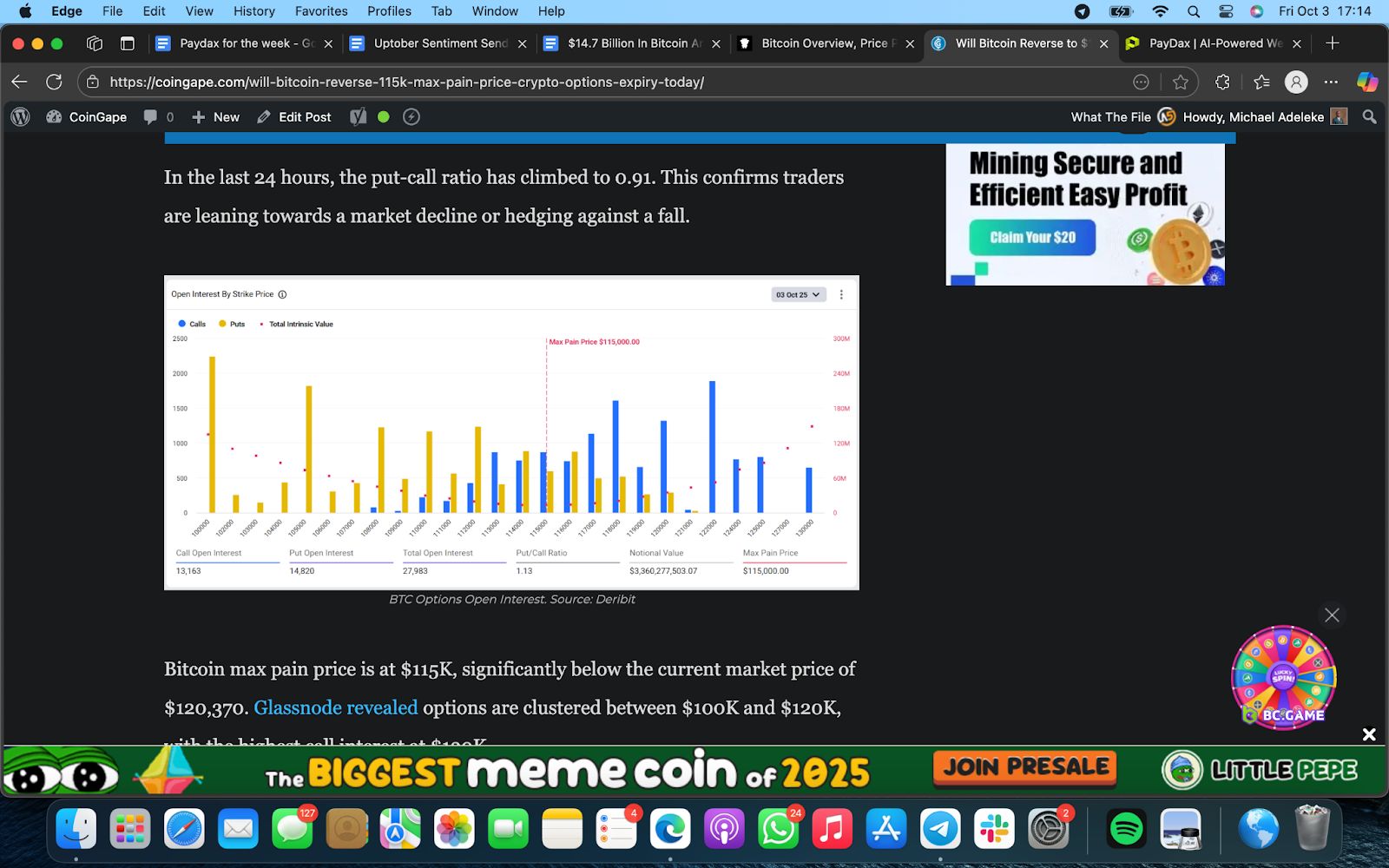
The crypto market opened on Friday on edge as Bitcoin (BTC) traded around $120,091, up 1.2%, while total capitalization hovered near $2.7 trillion. Traders are closely watching the expiry of $3.35 billion in BTC contracts on Deribit , with the “maximum pain” level sitting near $115,000. This expiry event left $14.7 billion in Bitcoin longs at risk. 

The put-call ratio of 1.13 indicates that puts outnumber calls, suggesting a bearish market outlook for Bitcoin. Over the past 24 hours, the ratio has risen to 0.91, indicating that BTC traders are positioning for a potential downturn.
$14.7 Billion In Bitcoin Are At Risk — Here’s What We Know So Far image 0

However, a breakdown of the Bitcoin price toward $115,000 could trigger cascading liquidations. Coinglass data also suggests a fall to $106,500 could wipe out nearly $15 billion in BTC positions. While Bitcoin long traders brace for impact, Paydax Protocol (PDP) is gaining traction in its new round of funding, recording a massive influx of investments just two weeks after its launch.

Bitcoin Liquidation Risks Highlight the Opportunity in Paydax Protocol (PDP)

While Bitcoin (BTC) faces liquidation risks, a new opportunity is gaining traction in the DeFi space. Typically, decentralized finance aims to create a system where money can be transferred without the need for banks or intermediaries. 

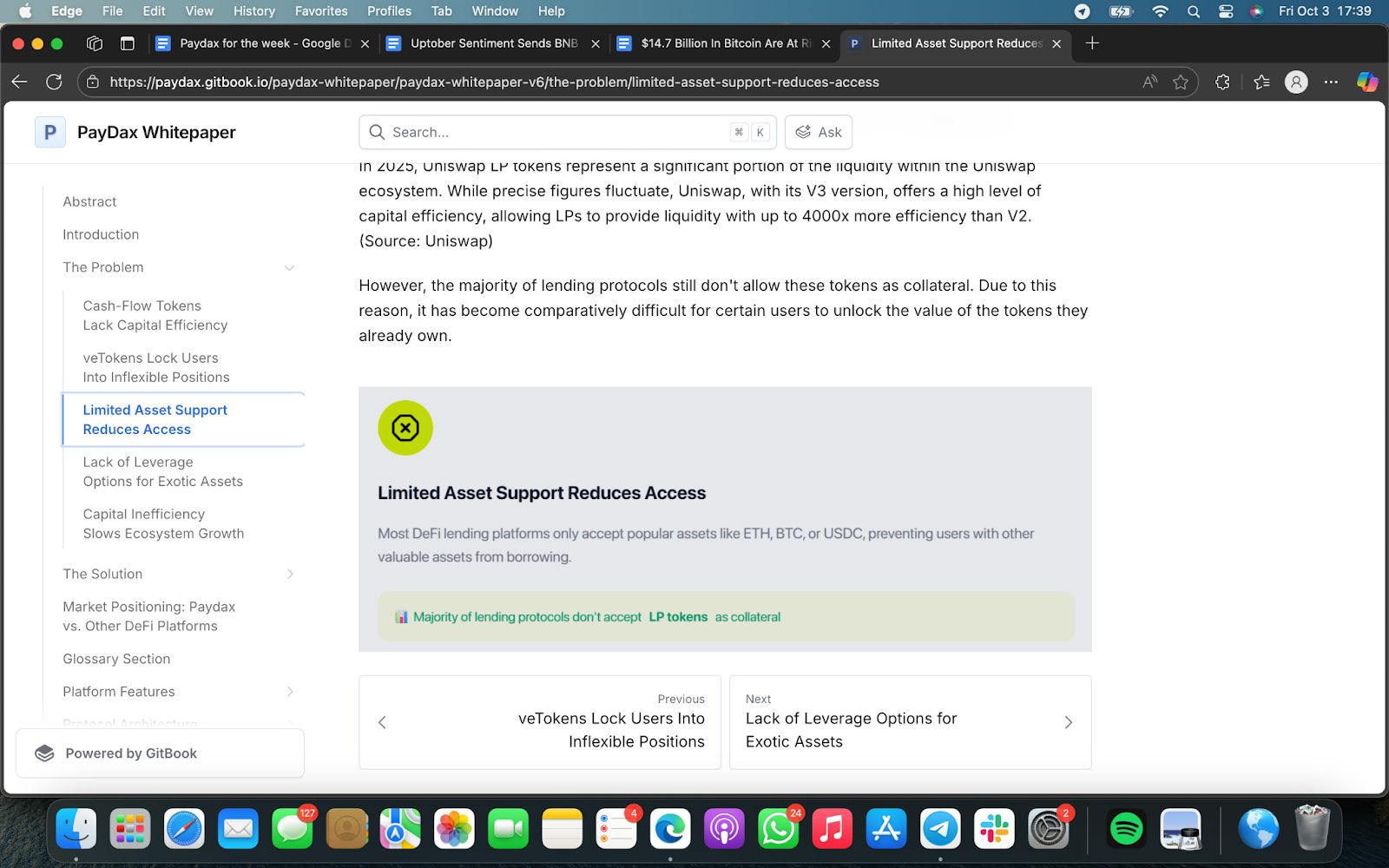
However, this system has several problems. Liquidity provider (LP) tokens and governance assets are usually locked in smart contracts and remain unused. Many platforms only support popular tokens, such as BTC, for lending.
$14.7 Billion In Bitcoin Are At Risk — Here’s What We Know So Far image 1 

This is the challenge that Paydax Protocol (PDP) aims to address. This platform was created to serve as the first community-driven DeFi bank. It transforms real-world assets and cryptocurrency into capital available for borrowing, lending, or staking.

Security You Don’t Have to Second-Guess

Paydax Protocol (PDP) transcends traditional safety protocols with features crafted to convert risk into opportunity. A key illustration is the Redemption Pool, where stakers serve as decentralized insurers. By underwriting loans, they safeguard the system and can earn up to a 20% APY in premiums.

The security layers include:  

  • Volatility Buffers: Additional time for borrowers to provide collateral or repay their loans before liquidation occurs.  

  • Emergency Shutdowns: A safety mechanism governed by the community that halts operations and secures funds during critical situations.  

  • Assure-DeFi, a reputable security firm, has audited Paydax Protocol’s (PDP) smart contract.

  • Multi-Signature Wallets: Transactions necessitate approvals from several trusted individuals using Gnosis Safe, which safeguards funds against errors or misuse.  

Paydax Protocol Borrowing Flow: A Secure Path to Liquidity

Paydax Protocol (PDP) introduces a simplified borrowing flow that transforms dormant collateral into active capital, empowering users to invest, expand, and grow with confidence. Here is the step-by-step layout of the process;

Deposit Collateral
Investors begin by selecting an approved asset and depositing it into their personal Paydax Protocol vault.

Borrow Assets

Once collateral is deposited, investors can borrow against it based on the fixed Loan-to-Value (LTV) ratio for that specific asset pair. 

Maintain Health Factor
The system monitors each borrowing position through a “Health Factor.” If it drops below 1.0, the position could be liquidated. In this case, up to 50% of the position would be liquidated with a 5% penalty to bring the factor back into a safe zone.

Repay and Unlock Collateral
To close a borrowing cycle, investors simply repay the borrowed assets plus the accrued simple interest. Once cleared, the deposited collateral is fully unlocked from the LendingPool.

0
0

Disclaimer: The content of this article solely reflects the author's opinion and does not represent the platform in any capacity. This article is not intended to serve as a reference for making investment decisions.

PoolX: Earn new token airdrops
Lock your assets and earn 10%+ APR
Lock now!

You may also like

ChainOpera AI Token Plummets Unexpectedly: Is This a Warning Sign for Crypto Investors Focused on AI?

- ChainOpera AI's 96% value collapse in late 2025 exposed critical risks in centralized, opaque AI-driven crypto projects. - 87.9% token concentration in ten wallets enabled manipulation, while untested AI algorithms and lack of audits eroded trust. - Regulatory ambiguity from delayed U.S. CLARITY Act and EU AI Act created fragmented frameworks, deterring institutional participation. - Post-crash trends prioritize decentralized governance, auditable smart contracts, and compliance with AML/KYC protocols fo

Bitget-RWA2025/12/12 14:02
ChainOpera AI Token Plummets Unexpectedly: Is This a Warning Sign for Crypto Investors Focused on AI?

Modern Monetary Theory and the Transformation of Cryptocurrency Valuation Models in 2025

- Modern Monetary Theory (MMT) reshaped crypto valuation in 2025, transitioning digital assets from speculative tools to institutional liquidity instruments amid low-yield environments. - Central banks and 52% of hedge funds adopted MMT-aligned CBDCs and regulated stablecoins, with BlackRock's IBIT ETF managing $50B as crypto gained portfolio diversification status. - Regulatory divergence (e.g., U.S. CLARITY Act vs. New York BitLicense) created volatility, exemplified by the Momentum (MMT) token's 1,300%

Bitget-RWA2025/12/12 13:42
Modern Monetary Theory and the Transformation of Cryptocurrency Valuation Models in 2025

Financial Wellness Emerging as a Key Investment Trend: Psychological and Structural Factors Shaping Sustainable Wealth Over Time

- 2025 investment trends prioritize financial wellness driven by behavioral economics and systemic factors like inflation and AI-driven tools. - Budgeting apps (YNAB, Mint) and automation platforms (Digit, Acorns) address debt management and savings discipline amid $1.17T U.S. credit card debt. - ETFs like iShares IYG and Global X FINX target financial wellness infrastructure, while Vanguard's inflation-protected ETFs cater to capital preservation needs. - Systemic shifts force "cascading waterfall" financ

Bitget-RWA2025/12/12 13:10
Financial Wellness Emerging as a Key Investment Trend: Psychological and Structural Factors Shaping Sustainable Wealth Over Time

Investing for Tomorrow: Eco-Friendly Energy Systems and the Growth of Green Cities

- Global climate-conscious energy infrastructure is accelerating, driven by tech innovation and urban decarbonization needs, with cities accounting for 70% of carbon emissions. - Smart grids and AI are transforming energy systems: grids optimize distribution (e.g., Amsterdam/Singapore), while AI cuts building energy use by 30% via automation and analytics. - Renewable energy investments hit $2.2T in 2025, led by solar (cheapest electricity source), but emerging markets face funding gaps despite hosting 40%

Bitget-RWA2025/12/12 13:10
Investing for Tomorrow: Eco-Friendly Energy Systems and the Growth of Green Cities
© 2025 Bitget