
Blockchain revenues down 16% in September according to VanEck

The crypto market moves, but not always in the expected direction. While the blockchain universe is often associated with soaring increases, September 2025 cooled down the enthusiasm. Less noise, less speculation, but also less revenue for networks. A lull that, instead of signaling decline, could indicate a deeper transformation. Fewer highlights, more maturity? That’s what the latest VanEck report suggests, which examines the health status of the blockchain sector.
In brief
- Blockchain revenues dropped 16% in September according to VanEck.
- Tron generated 3.6 billion dollars over the year thanks to stablecoins.
- Ethereum is preparing an update to speed up transactions and reduce costs.
- The ASTER token exploded by +1667%, driven by farming on Binance Chain.
Less volatility, less cash: blockchain digests its growth
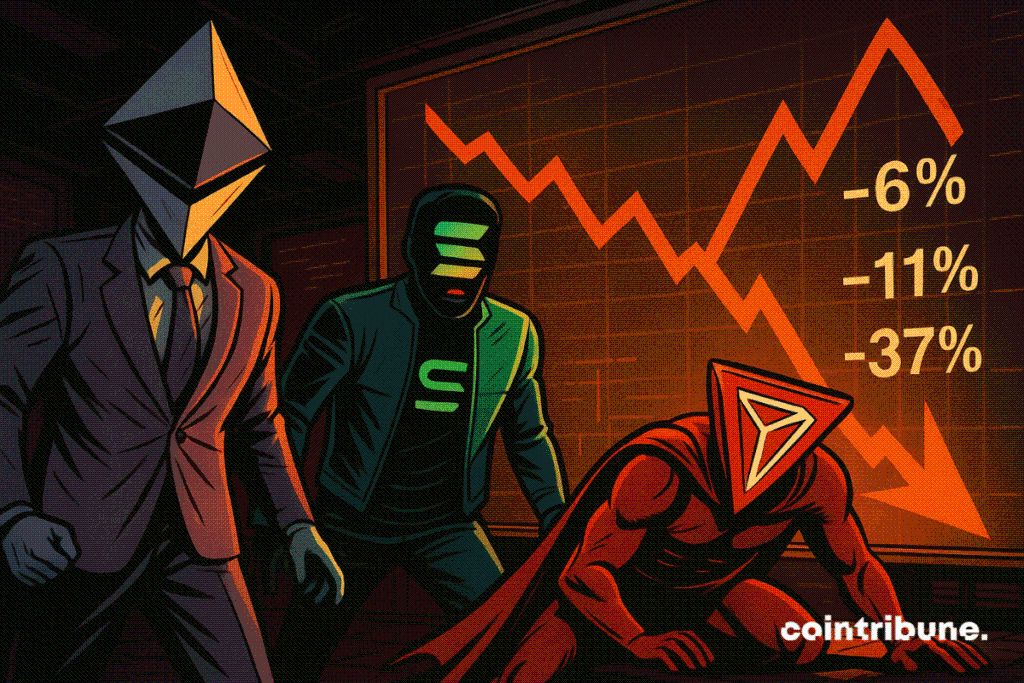
According to VanEck’s report, the combined revenues of major blockchains dropped 16% in September. Ethereum, Solana, and especially Tron saw their performance decline amidst decreasing token volatility. For example: Ether’s volatility fell by 40%, Bitcoin’s by 26%.
Result? Fewer arbitrage opportunities and therefore fewer high fees paid by traders.
VanEck explains it like this:
With lower volatility of digital assets, there are fewer arbitrage opportunities prompting traders to pay high priority fees.
VanEck Crypto Monthly Recap , Sept. 2025
Is this decrease worrying? Not necessarily. It can also mark a shift from speculative crypto to utility crypto. This is what some analysts call “the economic normalization of blockchains.”
Tron and stablecoins: the hidden face of blockchain success
While most networks suffered, Tron stands out. Despite a 37% revenue drop this month (following a fee reduction imposed by governance), the blockchain posts impressive annual figures: 3.6 billion dollars in revenue in one year, more than the 1 billion generated by Ethereum. And this, with a market cap 16 times smaller.
The reason? Stablecoins, which today make up a massive share of crypto activity. Tron hosts 51% of all circulating USDT. Used for fast, low-cost payments without banking intermediaries, stablecoins have transformed Tron into a financial logistics hub.
This central role in stablecoin settlements gives Tron a definite strategic advantage, especially in areas where access to banking infrastructure remains limited. While other blockchains seek their model, Tron capitalizes on a concrete use, grounded in the real needs of a transitioning economy.
The rise of stablecoins shows one thing: blockchain is no longer just speculation, but is woven into daily uses, from cross-border payments to informal finance.
Ethereum, Layer 2, enterprises: crypto restructures its foundations
In response to this transformation, giants like Ethereum and Solana are reorganizing. Ethereum is preparing “Fusaka,” an update that will ease the scalability of Layer 2s, thanks to a new lightweight validation method. Goal: lower costs, accelerate transactions, attract activity.
Solana, for its part, deployed the Alpenglow upgrade, reducing finality time by 80 times (from 12 seconds to 150 milliseconds). Another innovation: switching to a new token format, the P-token, which cuts computational load by 95%.
And enterprises? They are returning, but differently. After failed experiments in 2018-2020, players like J.P. Morgan, Société Générale, Circle, and OpenAI are relaunching private, targeted blockchains connected to public blockchains.
Figures reshaping the landscape
- Tron generated $3.6 billion in revenue in one year, versus $1 billion for Ethereum;
- 51% of circulating USDT are issued on the Tron network;
- Stablecoins exceeded $292 billion in market cap in October 2025;
- The ASTER token rose by +1667% since its launch in September;
- Coinbase recorded a 10.8% increase over the month, according to VanEck.
This overall revenue decline does not signal the end of the blockchain era but its reshaping. Adoption is diversifying, infrastructures adapting. Yet, a recent technical dossier reveals that Ethereum is undermined by invisible flaws at the very heart of its architecture. Further evidence that, in crypto, nothing is ever definitively secured.
Disclaimer: The content of this article solely reflects the author's opinion and does not represent the platform in any capacity. This article is not intended to serve as a reference for making investment decisions.
You may also like
Bitcoin Leverage Wipeout: Systemic Threats in Cryptocurrency Derivatives Markets
- 2025 Bitcoin leverage liquidation events ($19B+ in October, $543M in December) exposed systemic risks in crypto derivatives markets, with Bitcoin short positions disproportionately affected. - Crisis revealed interconnectedness between crypto and traditional finance, as stablecoin de-pegging and liquidity shocks impacted U.S. Treasury markets and midcap tokens. - Regulators intensified oversight: FSB identified stablecoin/CASP gaps, Basel Committee adjusted prudential rules, and 70%+ jurisdictions advanc

Clean Energy Market Fluidity: How REsurety's CleanTrade Platform is Transforming Institutional Participation and Risk Strategies in Renewable Energy Trading
- REsurety's CleanTrade platform standardizes green energy trading, boosting institutional liquidity and risk management. - Launched in 2025, it facilitated $16B in trades, enabling transparent VPPA/PPA/REC trading and ESG-aligned hedging. - CFTC oversight reduces counterparty risk, aligning with decarbonization goals amid policy uncertainties. - Despite challenges like rising rates, CleanTrade bridges gaps by standardizing pricing and aggregating demand.

The Emergence of Clean Energy Derivatives: How CleanTrade is Transforming Institutional Investment in Renewable Resources
- CleanTrade's CFTC-approved SEF designation in 2025 revolutionizes clean energy derivatives by introducing institutional-grade liquidity and standardized trading for VPPAs, PPAs, and RECs. - The platform's $16B notional trading volume within two months demonstrates rapid institutional adoption, with major players like Cargill leveraging its transparent infrastructure to manage energy risks. - Integrated ESG analytics and automated compliance tools enable investors to align portfolios with sustainability g

The Emergence of CFTC-Regulated Clean Energy Platforms and Their Influence on Institutional Investment Approaches
- CFTC-approved CleanTrade, the first SEF for VPPAs/RECs, transforms clean energy markets by addressing liquidity, transparency, and regulatory challenges. - Its $16B trading volume and Cargill-Mercuria's first transaction demonstrate institutional adoption of standardized, verifiable renewable energy assets. - CleanTrade enables ESG alignment through project-specific carbon tracking, reducing emissions by 15% for investors while complying with IRA-driven $2.2T global investments. - By bridging financial a

Trending news
MoreCrypto prices
More





