
The Brain, New Battleground for Tech Titans

After the Moon, space, the Internet, nanotechnologies, quantum computing, cryptos and artificial intelligence, one question arises: what is left to discover for Man? Myriads of things, of course. But there is one that fascinates as much as it frightens: the brain. At a time when Elon Musk and Sam Altman are injecting millions into neural interfaces, the boundary between human and machine becomes more porous. And in this race to fusion, the stakes go far beyond science fiction.
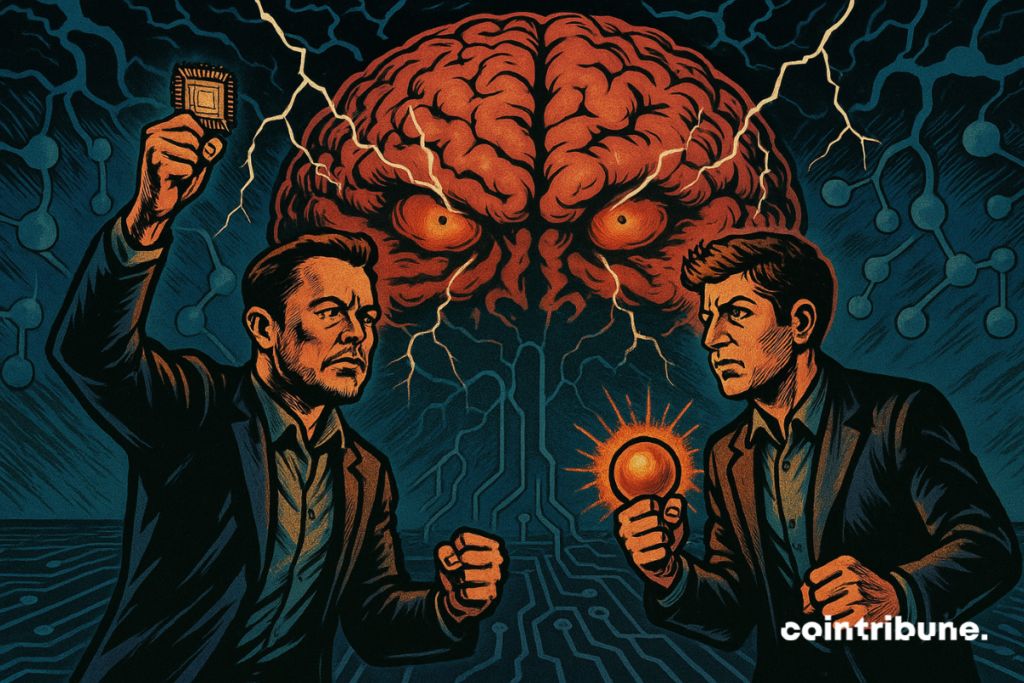
In brief
- Elon Musk is already implanting brain chips with Neuralink to merge AI and human thought.
- Sam Altman supports Merge Labs, betting on a softer, non-invasive neural interface.
- UCLA develops an AI co-pilot for EEG headsets, making robotic assistance more efficient.
- Experts warn of possible abuses if a few giants control access to our thoughts.
When AI meets neurons: the obsession of the pioneers
Neuralink, Merge Labs, Kernel… so many names that sound like the new temples of tech, with a common goal: to connect the human brain to the machine. Elon Musk does not hide it. Since 2016, he has aimed for a symbiosis between human and Artificial Intelligence to “preserve civilization.” Five patients have already received Neuralink implants, and one of them, Noland Arbaugh, now controls his computer with his thoughts.
His latest feat? A Mario Kart gaming session, completely by thought.
For Sam Altman, co-founder of OpenAI, it is with Merge Labs that he enters the fray. Less invasive, “softer” than Neuralink, his approach flirts with the idea of cerebral cohabitation between man and AI without heavy implants. Behind these projects lies the same idea: controlling the next interaction platform.
If one company owns the infrastructure, code, and data, they own the keys to an individual’s thoughts and intentions. This discourages transparency [and] slows independent validation and scientific progress. Access to BCI technology—and cognitive autonomy—is subject to the business decisions of a handful of high-profile figures. That is too much risk in too few hands.
Andreas Melhede, Elata Bioscience – Source: Decrypt
This race to connected AI is not trivial. For these titans, owning the brain-machine interface means owning the future. A power struggle with dystopian overtones, or a revolution, depending on the boundary one draws.
From implants to soft tech: a diversity of approaches
While Neuralink type implants make headlines, other visions are emerging, less invasive but equally promising. Researchers at UCLA, for example, have developed an AI assistant, a “co-pilot” , to improve the performance of non-invasive EEG headsets. Result? A paralyzed patient was able to manipulate a robotic arm, a task previously impossible without assistance.
The same story at Kernel, funded by Bryan Johnson, which aims to build the cognitive infrastructure of the future, rather than spectacular gadgets. The goal is clear: capture mental signals, analyze them en masse, and derive predictive models at the intersection of AI and neuroscience.
But not everyone shares the unbridled enthusiasm of billionaires. Tetiana Aleksandrova, founder of Subsense, reminds that:
Their funding can accelerate progress at a pace public funding rarely allows. At the same time, the pressure to deliver at startup speed can lead to unrealistic promises that put trust at risk. And in science, trust is just as critical as capital.
Tetiana Aleksandrova – Source: Decrypt
Between technological ambition and clinical reality, tension rises. Brain tech is no longer science fiction, but the field remains mine-filled.
The numbers behind the brain conquest
In this race, the numbers and facts are as spectacular as the ambitions. Here is an overview:
Points to keep in mind:
- Elon Musk’s Neuralink has raised 650 million dollars in series E;
- Patient Noland Arbaugh broke the world record for BCI control with 8.0 BPS;
- Merge Labs, supported by Sam Altman, targets a valuation of 850 million dollars;
- The non-invasive AI interface developed at UCLA allowed a patient to manipulate a robotic arm in 6 minutes.
These advances raise major questions. Who will have the right to read (or control) our thoughts? What place for ethics in this new intimate tech? Competition among AI giants is already shaping the rules of the game, well before the technology is available to the general public.
And yet, despite technical limits — still fuzzy signals, biological risks — the direction seems inevitable: tech is creeping into the brain, and AI is settling into our synaptic connections.
As tech titans fight over the cables of our brains, the crypto world is not left out. In the DeSci (decentralized science) universe, projects are emerging to transform scientific research with more transparency, collaboration, and fairness. What if the next cognitive revolution came not from giants, but from outsiders?
Disclaimer: The content of this article solely reflects the author's opinion and does not represent the platform in any capacity. This article is not intended to serve as a reference for making investment decisions.
You may also like
Ethereum network sees 62% drop in fees: Is ETH price at risk?

SOL Price Forecast: Solana Enters a New Phase with Network Enhancements and Market Fluctuations
- Solana's 2025 upgrades (Firedancer, Alpenglow) enable 1M TPS and 5,200x cheaper transactions, boosting institutional adoption. - TVL rebounded to $8.8B with 32.7% QoQ growth, supported by Bitwise ETF and 7% staking yields attracting institutional capital. - Fed's December 2025 rate cut and QT cessation create favorable macro conditions, historically correlating with crypto gains. - Technical indicators (RSI 42.5, bullish MACD) suggest strategic entry above 200-day EMA ahead of December FOMC meeting. - In

Solana's Abrupt Price Swings and Institutional Reactions: Analyzing Core and Market Factors Behind the Decline and Reviewing Long-Term Value
- Solana (SOL) plummeted 14% in late 2025 due to weak on-chain metrics, 7.5% inflation, and waning memecoin demand. - Institutional investors maintained 1% SOL treasury holdings and $101.7M ETF inflows despite macro risks and $19B crypto liquidations. - Alpenglow/Firedancer upgrades (1M+ TPS, 150ms finality) and 50-80% lower validator costs aim to strengthen Solana's infrastructure resilience. - Regulatory uncertainties (SEC ETF reviews, MiCA) and delayed $2.9B inflation reduction plan (2029) persist as sy

The Impact of Institutional Funding on Education and Workforce Training in Renewable Energy
- Institutional investors are boosting renewable energy education and workforce programs to drive long-term economic resilience and sustainability. - Global investments hit $386B in H1 2025, with education initiatives bridging skill gaps and enabling equitable clean energy transitions. - Case studies like Morocco’s 38% renewable electricity and Portugal’s green skills programs highlight education’s role in job creation and sector growth. - Education and green finance synergies in RCEP and U.S. $265B 2024 i

Trending news
MoreCrypto prices
More





