
The Hong Kong Monetary Authority has launched the Ensemble Sandbox program, accelerating the RWA process! | Mankiw Web3 Legal Education
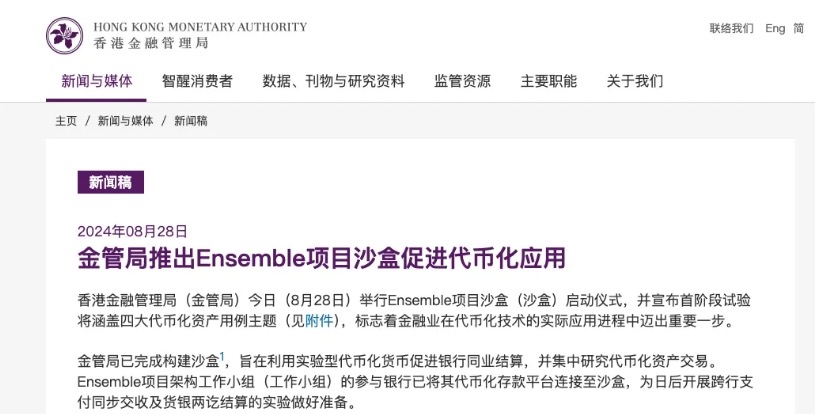
- Explore application scenarios: Allow participants to experiment with tokenized assets in a secure environment and explore various applications without immediately facing the pressure of full implementation.
- Technical Testing: Testing the compatibility between different digital assets, tokenized deposits, and CBDC. This stage is crucial to ensure the robustness of the technology and prepare for wider adoption.
- Establish industry standards: Establish common industry benchmarks for tokenization, which is crucial for the development of technology. By facilitating the entire lifecycle of tokenized asset transactions from creation to transaction to payment and settlement, Sandbox helps participants understand the actual impact of tokenization and its potential to solve real-world challenges, such as its application in supply chain financing.
- Solving real-world challenges: Sandbox promotes innovative applications aimed at solving practical problems in the financing field, especially in areas such as trade and supply chain finance. By addressing these pain points, Ensemble is helping to make tokenization a viable option for enterprises.
- Fixed Income and Mutual Funds: This topic explores how tokenization is changing traditional investment tools, making them more accessible and efficient. By creating digital representations of bonds or Mutual Funds, the financial industry can reduce settlement time, lower costs, and enhance liquidity, providing new opportunities for investors.
- Liquidity Management: Tokenization has the potential to revolutionize liquidity management by allowing assets to be split and traded on digital platforms. This could lead to more dynamic and efficient liquidity management, especially where quick access to funds is critical.
- Green and Sustainable Finance: The MAS also focuses on how tokenization can support green and sustainable finance initiatives. By tokenizing assets such as green bonds or carbon credits, the financial sector can enhance transparency and traceability, ensuring that funds are effectively allocated to environmental projects.
- Trade and Supply Chain Finance: Tokenization can solve major pain points in trade and supply chain finance by simplifying the process of tracking and transferring ownership of goods and financial assets. This can improve the efficiency and transparency of the supply chain, reduce fraud risks, and enhance overall market confidence.
- Enhance liquidity. Traditional real-world assets like real estate tend to be illiquid, meaning they can be difficult to sell quickly. Tokenization allows these assets to be split into smaller tokens that are easier to trade, improving liquidity.
- Increase accessibility. Tokenization makes asset classes that were previously inaccessible to many investors more widely accessible. For example, people with limited capital can purchase a small portion of high-value assets (such as real estate) through tokens.
- Reduce transaction costs. Blockchain technology can reduce the cost of trading and transferring assets as it eliminates the need for intermediaries such as brokers or custodial agents.
Disclaimer: The content of this article solely reflects the author's opinion and does not represent the platform in any capacity. This article is not intended to serve as a reference for making investment decisions.
You may also like
Clean Energy Market Fluidity: Ushering in a New Age with CFTC-Sanctioned Platforms
- REsurety's CleanTrade, the first CFTC-approved SEF for clean energy , is transforming market liquidity and transparency by standardizing VPPAs, PPAs, and RECs. - The platform attracted $16B in notional value within two months, enabling institutional investors to hedge energy risks while aligning with ESG goals through verifiable decarbonization metrics. - Renewable developers benefit from streamlined financing and securitization tools, creating predictable revenue streams and expanding access to capital
Investing in Human Capital for a Greener Tomorrow: The Growth of Education and Career Training in Renewable Energy
- Global energy transition drives rapid growth in renewable workforce demand, with U.S. wind turbine technician roles projected to surge 60.1% by 2033. - Institutions like Farmingdale State College bridge skill gaps through industry-aligned programs, offering hands-on training and partnerships with firms like Orsted and GE . - Investors gain strategic opportunities by funding vocational training and microcredentials, addressing decarbonization needs while boosting social equity through inclusive initiative
Clean Energy Market Fluidity: The CFTC-Endorsed Transformation
- CFTC approved CleanTrade as the first SEF for clean energy , addressing market fragmentation and liquidity gaps. - The platform enables institutional-scale trading of VPPAs and RECs with automated compliance and $16B in early trading volume. - Integrated analytics and regulatory compliance enhance transparency, reducing risks for investors in renewable energy assets. - Early adoption by Cargill and Mercuria highlights CleanTrade's potential to reshape $1.2T clean energy investment landscape.

How iRobot Strayed from Its Original Path
Trending news
MoreCrypto prices
More





