
This Privacy Coin Explodes 30% in a Week: Details

PRVC aims to be the first of its kind, tracking the performance of companies from traditional finance and web3 alike in the privacy technology and cybersecurity sectors.
Zcash (ZEC) exploded roughly 30% weekly after Grayscale filed a request for a privacy-centered ETF that tracks companies from that sector, including privacy coins, AI, data security, and more.
Grayscale approached the SEC this week with a proposal for a unique exchange-traded fund (ETF) focused on privacy and cybersecurity, the Grayscale Privacy ETF (PRVC), as revealed in the Form N-1A filing.
Privacy-Related ETF?
The filing specifies that companies must derive more than 50% of their revenues from the outlined sub-themes to be considered for inclusion in the Index. These and other conditions apply, such as meeting the liquidity criteria and having a market capitalization of no less than $250 million, among others.
Regarding the ETF’s investment strategy, the filing indicates that the Privacy ETF’s Index will allocate 10% of its assets to Privacy-Preserving Protocols via the Grayscale Zcash Trust (ZCSH).
Privacy Coins Pump Alongside AI Tokens
ZCash operates on a decentralized, open-source network, enabling users to transact without revealing sensitive information, such as transaction parties.
Interestingly, privacy tokens have managed to do relatively well in the last seven days, with most of them seeing double-digit increases, according to data from CoinMarketCap.
ZEC currently ranks fifth among the largest privacy tokens by market capitalization, trailing Oasis Network (ROSE), Worldcoin (WLD), Monero (XMR), and Internet Computer (ICP). Alongside ZEC, Worldcoin has seen explosive growth this week, surging 75%.
Worldcoin, however, is the top gainer in the leaderboard, surging over 180%. As CryptoPotato reported , the project recently hit a million users shortly after the launch of Sora, the new text-to-video tool that’s rocking the art and videography community.
Note that the scenario for privacy tokens runs rife with heavy regulatory scrutiny and controversy, especially AI-based projects like Worldcoin.
Disclaimer: The content of this article solely reflects the author's opinion and does not represent the platform in any capacity. This article is not intended to serve as a reference for making investment decisions.
You may also like
Research Report|In-Depth Analysis and Market Cap of Talus (US)
Five charts to help you understand: Where does the market go after each policy storm?
After this regulatory crackdown, is it a harbinger of an impending downturn, or the beginning of a new cycle where all negative news has been fully priced in? Let’s examine the trajectory after the storm through five key policy milestones.

Mars Morning News | The crypto market rebounds across the board, Bitcoin rises above $94,500; The "CLARITY Act" draft is expected to be released this week
The crypto market has fully rebounded, with bitcoin surpassing $94,500 and US crypto-related stocks rising across the board. The US Congress is advancing the CLARITY Act to regulate cryptocurrencies. The SEC chairman stated that many ICOs are not securities transactions. Whales are holding a large number of profitable ETH long positions. Summary generated by Mars AI. The accuracy and completeness of the content generated by the Mars AI model is still being iteratively updated.
Federal Reserve’s Major Shift: From QT to RMP, How Will the Market Transform by 2026?
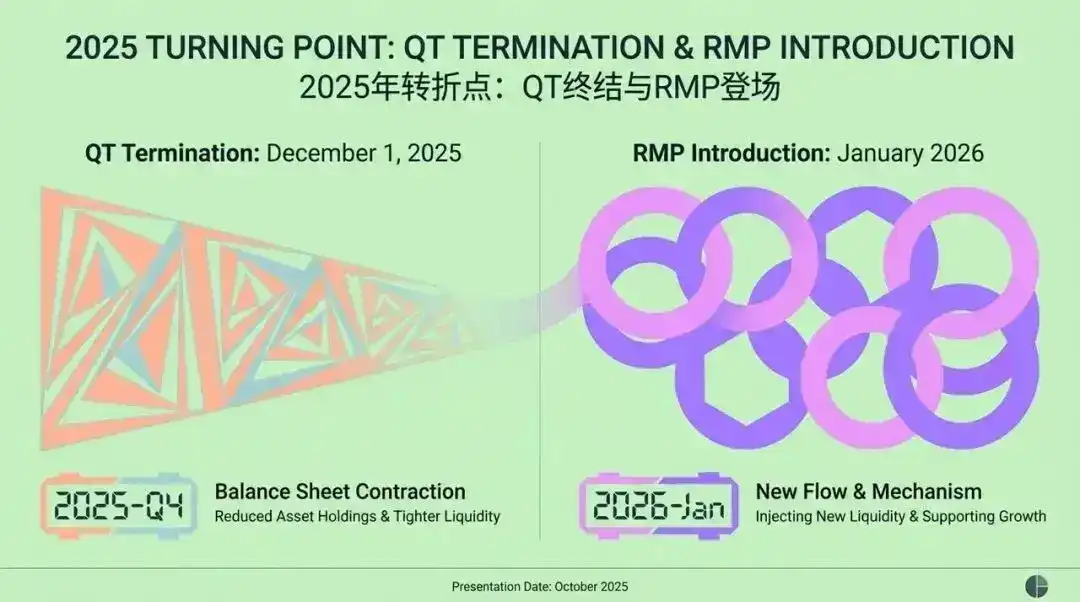
The article discusses the background, mechanism, and impact on financial markets of the Federal Reserve's introduction of the Reserve Management Purchases (RMP) strategy after ending Quantitative Tightening (QT) in 2025. RMP is regarded as a technical operation aimed at maintaining liquidity in the financial system, but the market interprets it as a covert easing policy. The article analyzes RMP's potential effects on risk assets, the regulatory framework, and fiscal policy, and provides strategic recommendations for institutional investors. Summary generated by Mars AI This summary was generated by the Mars AI model, and the accuracy and completeness of its content are still in the process of iterative improvement.
Trending news
MoreCrypto prices
More





