
Bullish Divergence Poses a Threat to Bearish Dominance at HBAR’s $0.16 Support Level
- HBAR dropped 1.7% to $0.170 as institutional selling pushed it below $0.1720, with 71% higher trading volume. - Technical analysts note RSI bullish divergence but bearish control persists, requiring a $0.19 breakout for validation. - Short positions dominate futures markets ($44.88M vs $14.11M), risking a short squeeze if buyers reclaim $0.19. - Market structure remains bearish despite temporary rebounds, with $0.16 support critical for avoiding deeper correction.
HBAR, which is the primary token for
The recent decline has sparked debate about whether the market is nearing a turning point. Technical analysts highlight a bullish divergence in the Relative Strength Index (RSI), an important metric that indicates fading bearish pressure, as reported by
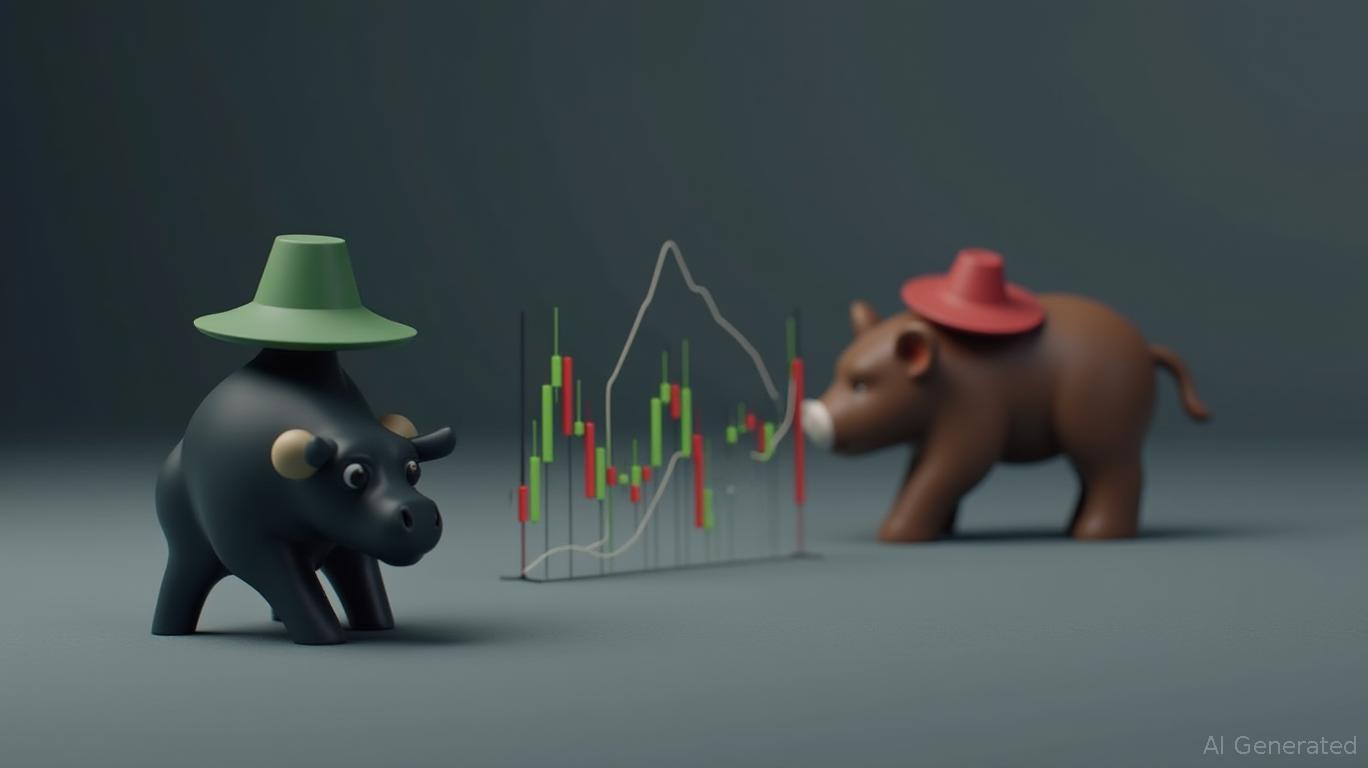
Despite the recent uptick, the overall market structure remains bearish.
Wider market conditions add further challenges. HBAR has lost nearly 25% in the past week amid $1 billion in futures liquidations, indicating a major shakeout. While trading volumes remain high at $351 million, open interest has dropped to $151.94 million, showing less speculative involvement. This is in contrast to earlier this year, when a similar drop in inflows was followed by a 117% surge from $0.13 to $0.29.
Investors are staying cautious as HBAR forms a broadening wedge pattern, a technical setup that often comes before sharp price swings. If the price can hold above $0.19, a move toward $0.23 is possible, but bears remain in control unless institutional buyers defend the $0.16 support. For now, the token’s outlook depends on whether the recent bounce marks a true bottom or just a brief pause in a longer decline.
Disclaimer: The content of this article solely reflects the author's opinion and does not represent the platform in any capacity. This article is not intended to serve as a reference for making investment decisions.
You may also like
Solana's Abrupt Decline: Underlying Factors and What It Means for Investors
- Solana’s Q3 2025 sell-off reflects strong network performance (80M daily transactions) but a $352.8M company net loss from derivatives and financing costs. - Market sentiment diverged: $113.5B market cap growth vs. 6.87% stock drop post-earnings, driven by macroeconomic risks and regulatory uncertainty. - Upgrades like Alpenglow (150ms finality) and ZK Compression v2 (5,200x cost reduction) position Solana for institutional adoption despite short-term volatility. - Investors face a dilemma: 32.7% DeFi TV

DASH Price Increases by 1.78% Following Significant Insider's Share Sale Filing
- DoorDash’s stock rose 1.78% on Dec 2, 2025, despite a 20.32% weekly drop, showing long-term investor confidence. - Officer Lee Gordon S filed to sell 2,159 shares via Rule 10b5-1 plan, part of routine insider trading strategy . - Director Alfred Lin bought $100M in DASH shares, contrasting with 90-day insider sales of $174.5M. - Institutional investors showed mixed activity, with Panagora buying and Spyglass, Arrowstreet reducing stakes. - Analysts maintain "Moderate Buy" rating, projecting growth amid v

What's Causing the Latest BTC Price Swings: Is It a Macro-Fueled Reevaluation?
- Bitcoin's late 2025 volatility reflects macroeconomic pressures, Fed policy shifts, and regulatory changes impacting institutional demand. - Sharp price swings from $126k to $87k highlight sensitivity to inflation, interest rates, and leveraged trading risks amid delayed economic data. - New U.S. crypto laws and ETF approvals boosted institutional participation, but geopolitical risks and token unlocks maintained uncertainty. - A potential Fed rate cut and stabilizing inflation could reignite risk appeti
The ChainOpera AI Token Collapse: A Cautionary Tale for AI-Powered Cryptocurrency Markets?
- ChainOpera AI (COAI) token's 96% collapse in late 2025 exposed systemic risks in AI-blockchain markets, mirroring 2008 crisis patterns through centralized governance and speculative hype. - COAI's extreme centralization (96% supply in top 10 wallets) and tokenomics (80% locked until 2026) created liquidity crises, undermining blockchain's decentralized ethos. - Regulatory actions intensified post-crash, with SEC/DOJ clarifying custody rules and targeting fraud, yet CLARITY/GENIUS Acts created compliance

Trending news
MoreCrypto prices
More






