
Market Flash Crash, Funds Seeking Exit on-chain: A Comprehensive Look at the Contract DEX Yield Farming Battle

The market flash crash has exposed the centralization risks in the crypto industry, providing DEX with a development opportunity.
The largest-scale liquidation event in recent history, a $19 billion leveraged bet, occurred last Friday evening with most of the trading volume coming from just three centralized exchanges. This exposed a continuing vulnerability: the industry is still too centralized, with power and risk highly concentrated in the hands of a few giants. This was not just a digital liquidation but also a severe questioning of the core principles of the crypto industry. This is also the golden moment for DEXs. In the midst of this chaotic battlefield, Hyperliquid has loudly proclaimed itself as "The House of All Finance," a positioning that truly reflects their development direction. Grvt has also openly stated its long-term vision of becoming the highest-yielding exchange, occupying a strategically unique position in the perpetual contract DEX field that no other platform is currently focusing on.
DEX Overview
As of October 15, 2025, here is a comparison of the basic fee rates and related yield features of several major perpetual contract DEXs:
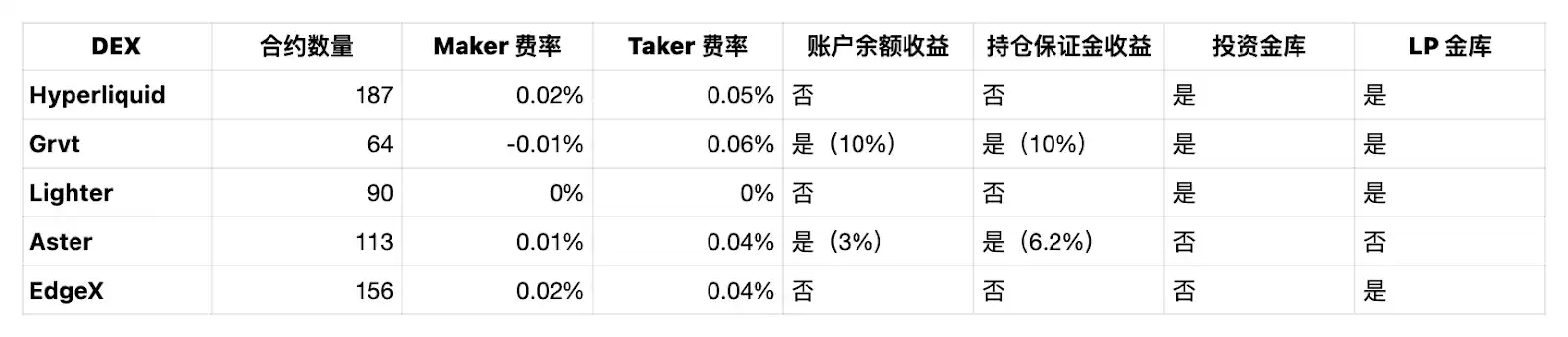
Currently, Hyperliquid has the most perpetual contract trading pairs, while Grvt has the fewest number of contracts.
However, in terms of Maker fees (i.e., limit order placement fees), Grvt has surpassed its competitors. It even charges a negative fee for Maker trades—meaning traders not only receive airdrop rewards when placing limit orders but also earn actual USDT profits.
In contrast, although Grvt has the highest Taker fee (market order), this part is more valuable during point farming as it directly affects future Grvt airdrop rewards.
In terms of Account Balance Yield, Grvt and Aster stand out:
· Grvt offers a 10% APY on users' USDT trading account balance, with the rewards paid in USDT;
· Aster provides a 3% APY on users' USDF balance, with rewards paid in USDF.
For Margin Yield, Grvt and Aster are also leading:
· Grvt offers 10% APY on USDT regardless of whether the user's USDT is idle in their account or used as collateral for positions;
· Aster, on the other hand, provides an additional 3.2% APY when the user uses USDF as collateral, accumulating to a total of 6.2% APY.
On the Investment Vault, apart from Aster and EdgeX, all other platforms allow users to invest in the exchange's internal vault, earning potential returns outside of trading. Except for Aster, most other platforms are equipped with LP (Liquidity Provider) vaults.
How to Earn Yield on These DEXes (Apart from Trading and Airdrops)?
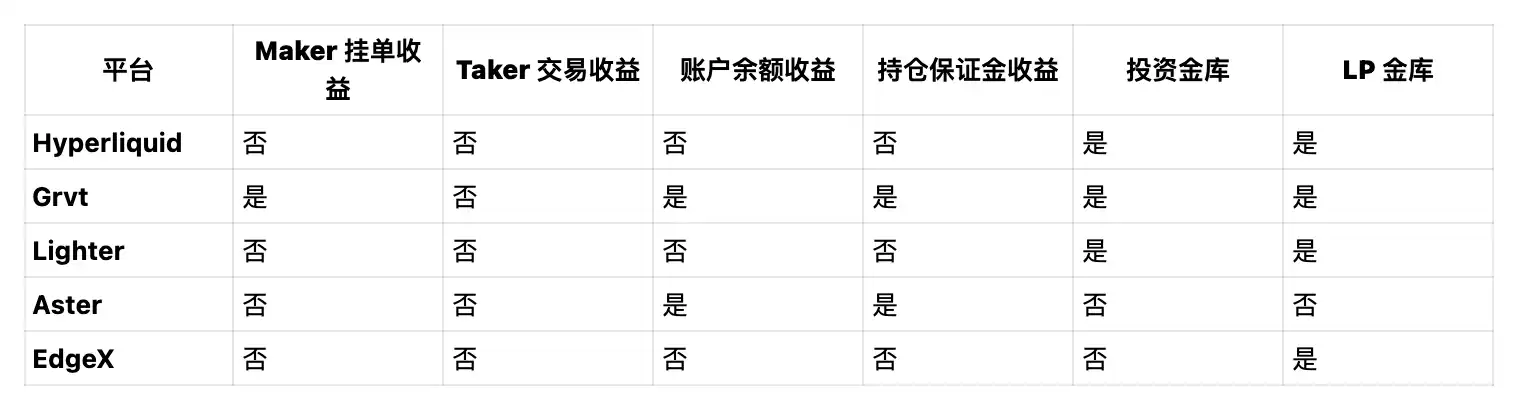
From the table above, Grvt is currently the only platform within perpetual contract DEXes that offers multiple yield avenues, not limited to just trading or points farming.
While Aster stands out with its unique account balance and collateral yield mechanism, it still falls short compared to competitors in the most common investment vault and LP vault aspects.
Conclusion
By enabling earning negative fee rate rewards through limit order execution and providing the highest APY for both accounts and positions, Grvt is gradually realizing its vision of being the "highest-yielding trading platform." With the intense competition among perpetual contract DEXes, we may witness more innovative product forms and yield structures in the future. The future of decentralized perpetual contracts is becoming increasingly anticipated.
Disclaimer: The content of this article solely reflects the author's opinion and does not represent the platform in any capacity. This article is not intended to serve as a reference for making investment decisions.
You may also like
Dogecoin Could Reboot Soon: Rising Wallets Signal Accumulation Around Key Zones

The Impact of New Financial Crises on Technology-Based Asset Classes: Systemic Threats and Hedging Strategies in AI and Blockchain Investment
- AI and blockchain reshape finance but introduce systemic risks like synchronized market crashes. - 2025 Bank of England study warns AI-driven strategies using shared data could trigger cascading liquidity crises. - Blockchain offers resilience via DeFi platforms but crypto volatility creates feedback loops in traditional banking. - Strategic hedging combines AI dynamic portfolios (12% 2024 outperformance) with NIST/EU regulatory frameworks to mitigate risks. - Future stability requires balancing AI innov

New Prospects in Security Technology and Advancements in Cybersecurity
- Post-cyberwarfare era demands AI-integrated defense-grade security as cyber threats evolve, with AI cybersecurity market projected to grow from $22.4B (2023) to $136.18B by 2032 at 24.81% CAGR. - Key drivers include cloud/IoT expansion, regulatory mandates (e.g., U.S. NSF privacy research), and institutional innovation like federal talent programs and startup collaborations. - Real-world applications show AI mitigating ransomware (Darktrace) and zero-day attacks (Cylance), while military operations lever

COAI Experiences Significant Price Decline and the Enduring Insights for Investors Focused on the Long Term
- ChainOpera AI (COAI) collapsed from $44.90 to $0.52 in late 2025 due to market shifts, structural flaws, and regulatory uncertainty. - COAI's 88% supply concentration and 60 manipulative wallets exacerbated liquidity crises amid sector-wide AI token outflows to meme coins. - Regulatory pressures (GENIUS Act, FSB) and algorithmic stablecoin collapses (xUSD, deUSD) deepened distrust in DeFi, compounding COAI's decline. - Long-term investors may find opportunities in COAI's collapse by applying margin of sa
Trending news
MoreCrypto prices
More





