
3 US Crypto Stocks to Monitor Amid Iran-Israel Conflict

Crypto US stocks are moving in opposite directions—Circle (CRCL) climbs toward resistance, while GLXY and RIOT struggle amid rising tensions.
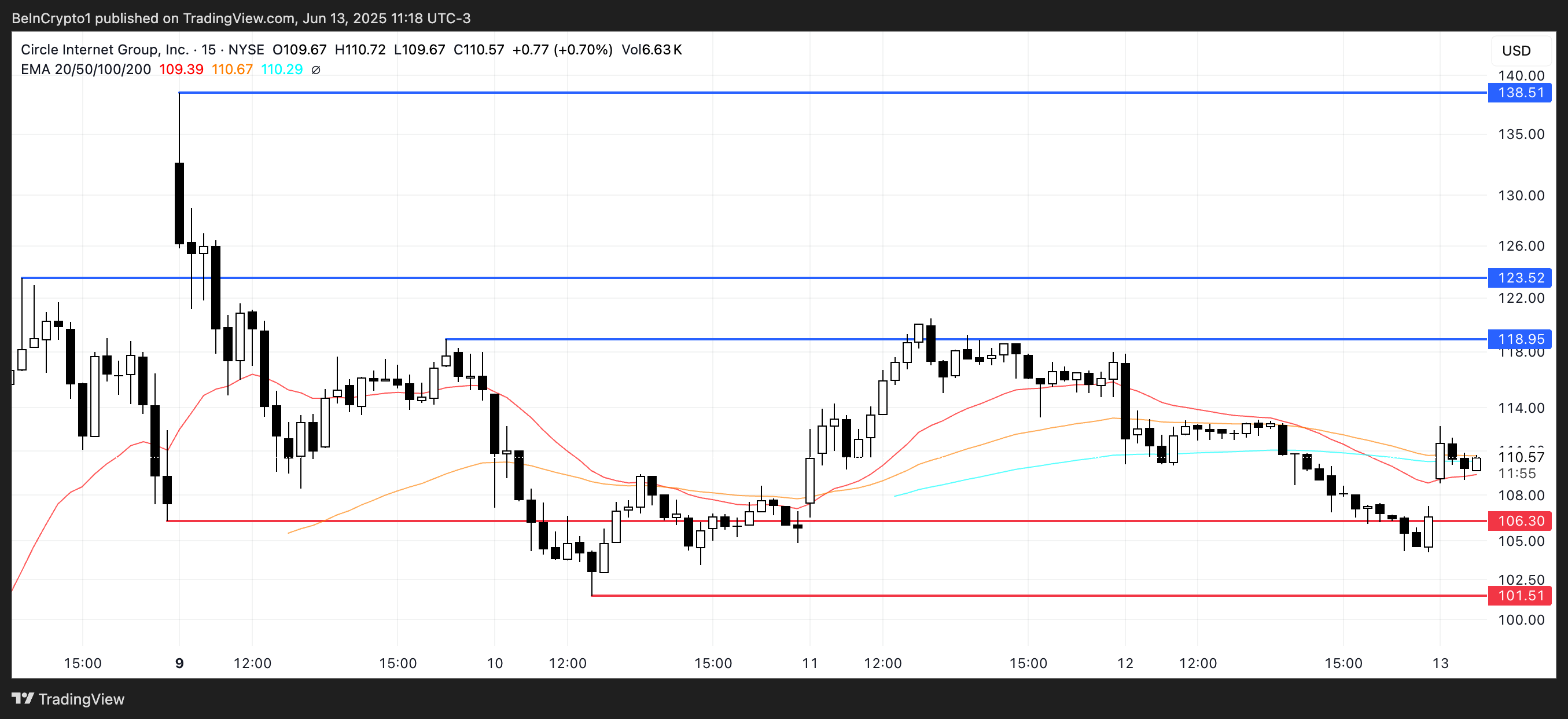
Crypto US stocks are showing mixed signals amid the escalating Iran-Israel conflict, with Circle (CRCL), Galaxy Digital (GLXY), and Riot Platforms (RIOT) all reacting to heightened market volatility. CRCL has surged over 250% since its IPO and is approaching a key resistance at $118.95.
In contrast, GLXY has been down more than 21% since its Nasdaq debut, while RIOT dropped over 9% in the last 24 hours, in tandem with Bitcoin’s pullback.
Circle Internet Group (CRCL)
Circle’s USDC stablecoin is now live on the XRP Ledger, marking a major step in cross-chain integration and stablecoin adoption.
The native launch—requiring no bridges—brings USDC directly to XRPL’s fast, low-cost infrastructure, allowing institutions and developers to access liquidity through Circle APIs and Circle Mint.
 CRCL Price Analysis. Source:
TradingView.
CRCL Price Analysis. Source:
TradingView.
Ripple and Circle emphasized their shared focus on regulatory compliance and financial accessibility. Ripple aims to capture 14% of global SWIFT liquidity by 2030.
Meanwhile, Circle’s stock (CRCL) has surged more than 250% since its IPO, riding the momentum from its expanding stablecoin footprint and successful integrations.
Price action is now approaching key technical levels, with resistance at $118.95 in sight—if broken, a push to $123.25 could follow. However, if the support at $106.30 fails, CRCL could retrace to $101.51.
Galaxy Digital (GLXY)
Galaxy Digital (GLXY) has struggled to gain momentum since debuting on the Nasdaq, currently down more than 7.4% over the last five days and over 21% since its listing.
Despite this price weakness, Galaxy CEO Mike Novogratz remains deeply bullish on Bitcoin. In a recent CNBC interview, he stated that “Bitcoin will replace gold” and could eventually reach $1,000,000. He described Bitcoin as a fully institutionalized macro asset benefiting from a global shift away from the U.S. dollar.
 GLXY Price Analysis. Source:
TradingView.
GLXY Price Analysis. Source:
TradingView.
Technically, GLXY is nearing a key support zone. If the current downtrend continues, the stock could test $18.27, and a break below that may push it down to $17.99.
On the upside, a reversal could see GLXY retest resistance at $18.77. If that level is cleared with strength, the next targets would be $19.56 and $20.11.
Riot Platforms (RIOT)
Riot Platforms (RIOT) has remained active on multiple strategic fronts, despite recent market pressure. The company recently appointed Jonathan Gibbs as its new Director of Data Center, signaling a major step toward expanding its digital infrastructure beyond Bitcoin mining.
With over 15 years of experience and a track record across North America, Europe, and Asia, Gibbs will lead Riot’s push into artificial intelligence and cloud data center markets—an effort backed by a pipeline of 1.7 gigawatts in available power.
At the same time, Riot recently disclosed it reduced its stake in Bitfarms to 14.3%, possibly reallocating resources to fund its long-term pivot toward broader tech infrastructure, including hyperscale data centers and AI-driven platforms.
 RIOT Price Analysis. Source:
TradingView.
RIOT Price Analysis. Source:
TradingView.
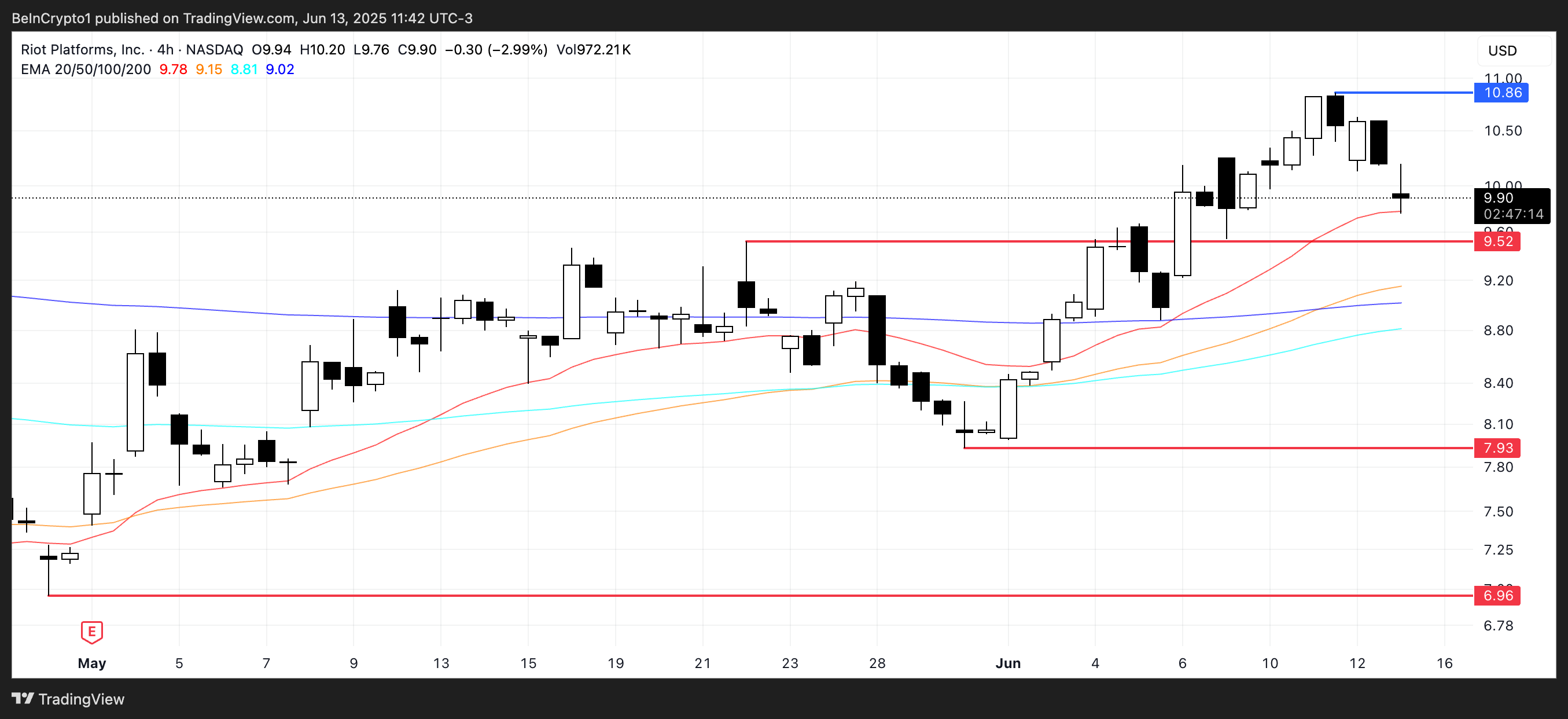
Still, RIOT’s stock has taken a sharp hit, dropping more than 9% in the last 24 hours as Bitcoin declined amid rising geopolitical tensions between Israel and Iran.
If sentiment recovers, the stock could rebound toward resistance at $10.86—and if that level breaks, a move toward higher ground may follow.
On the downside, continued weakness could push RIOT toward support at $9.52, and a break below that would expose it to deeper losses near $7.93.
Disclaimer: The content of this article solely reflects the author's opinion and does not represent the platform in any capacity. This article is not intended to serve as a reference for making investment decisions.
You may also like
Emerging Trends in Educational Technology Tokenomics: The PENGU Token’s Tactical Advancement
- Higher education institutions explore blockchain to address funding pressures through decentralized governance and tokenomics models. - PENGU token's retail-driven ecosystem demonstrates how community governance and utility tokens could inspire educational stakeholder engagement. - Theoretical frameworks suggest tokenization could diversify university funding via micro-credentials and RWA, though technical and regulatory barriers persist. - Pudgy Penguins' success highlights tokenomics' scalability poten
The Growing Opportunities for Investment in Education Platforms Powered by Technology
- Global higher education EdTech market reached $85.43B in 2025, projected to hit $169.72B by 2028 at 10.3% CAGR, driven by AI, SaaS, and ROI-focused strategies. - AI tools like Georgia State's "Pounce" chatbot and SaaS platforms (Microsoft 365, Google Workspace) improve efficiency, reduce administrative costs, and enhance student engagement. - Institutions prioritize EdTech investments with measurable ROI, forming partnerships with vendors like CDW to streamline procurement and quantify cost savings. - Ve

COAI Price Decline and Its Impact on AI-Powered Technology Shares: Strategic Risk Evaluation in Developing Tech Industries
- ChainOpera AI's 88% token price collapse exposed systemic risks in AI-blockchain convergence, driven by governance failures, token concentration, and regulatory ambiguity. - The crisis triggered sector-wide volatility in AI-linked commodities and shifted investor preferences toward pure AI startups over blockchain-integrated projects. - Global regulators are tightening oversight of AI/finance integration, while experts warn of overvalued AI markets and advocate diversified, factor-based investment strate

HYPE Token Experiences Rapid Rise: Is It Driven by Speculation or Genuine Long-Term Potential?
- HYPE token surged to $41.28 in November 2025 due to social media hype and FOMO-driven trading, then plummeted to a seven-month low near $27.43. - Ecosystem developments like Hyperion DeFi's token allocations and USDH partnerships provided limited utility validation, overshadowed by speculative retail trading dynamics. - Price collapse was accelerated by bearish technical indicators and lack of major exchange listings, exposing risks of retail-driven volatility without fundamental upgrades. - Investors de

Trending news
MoreCrypto prices
More





